

Pacific Nations gather in Honiara to strengthen regional geohazards monitoring and early warning
Honiara, 11 August 2026: Representatives from across the Pacific have gathered in Honiara for a week-long series of meetings this week to strengthen regional cooperation on earthquakes, tsunamis, volcanoes and landslides.
Hosted by the Solomon Islands Government from 10–14 August 2026, the meetings include the Annual Oceania Regional Seismic Network (ORSNET) Meeting, the 11th Meeting of the Pacific Tsunami Warning System Regional Working Group for Pacific Island Countries and Territories (WG-PICT), and the Third Regional Geohazards Meeting.
Opening the meetings, ORSNET Chairperson Mr Rennie Vaiomouga said the Pacific lives in one of the most geologically active regions in the world, with more than 15 million people exposed to geohazards.
“The impacts of earthquakes, tsunamis, volcanic eruptions and landslides on our people, livelihoods, infrastructure and economies are part of our reality,” Mr Vaiomouga said.
He recalled major events including the 1998 Aitape tsunami in PNG, the 2007 Solomon Islands earthquake and tsunami, Samoa 2009, Santa Cruz 2013, Ambae volcanic crisis 2018, the 2022 Hunga Tonga-Hunga Ha’apai eruption and tsunami, and the magnitude 7.3 earthquake near Efate, Vanuatu in December 2024.
“These are not simply dates in our disaster records. They represent lives lost, families displaced, infrastructure destroyed and impacts on our economy,” he said.
Mr Vaiomouga said ORSNET was established as a commitment by Pacific countries to share data, knowledge, expertise and responsibility. He noted that information from one country can help protect communities in another, as seen during the Tonga eruption and the 2024 Vanuatu earthquake when regional cooperation helped fill communication gaps.
The meetings bring together national seismic, volcano, landslide and tsunami observatories, disaster managers, and warning centres from ORSNET member countries, alongside regional organisations including SPC and SPREP, and international partners such as UNESCO/IOC, UNDRR, PTWC, USGS and Geoscience Australia.
ORSNET serves as the principal regional mechanism for seismic data-sharing in the Southwest Pacific and is recognised within PTWS as a key contributor to regional early warning arrangements.
This year’s meeting expands the focus to a multi-hazard approach covering seismic, volcano, landslide and tsunami risks. Over five days, delegates will review national monitoring arrangements, identify gaps in systems and data-sharing, and validate priority actions and governance arrangements for ORSNET, ORVNET, ORLNET and WG-PICT.
Mr Vaiomouga highlighted ongoing challenges including uneven distribution of monitoring stations, difficulties maintaining equipment across remote islands, and shortages of trained staff to install instruments, analyse data and issue timely warnings.
“Technology alone cannot resolve these challenges. We need trained people to maintain seismic stations. Skilled analysts to transform data into actionable information. And technically accurate warnings that are communicated clearly, quickly and inclusively to those at risk,” he said.
He called for sustained investment in systems, people and institutions, and for predictable, multi-year financing to strengthen national networks and ensure systems remain operational.
“Geological hazards do not operate according to project cycles. The cost of preparedness will always be less than the human, social and economic cost of failing to prepare,” Mr Vaiomouga said.
Key objectives of the meeting include:
- Review current national capacities, constraints and needs for monitoring and early warning
- Identify technical, institutional and coordination gaps affecting data-sharing and warning performance
- Validate and endorse implementation plans for ORSNET, ORVNET, ORLNET and WG-PICT
- Develop formal WG-PICT/PTWS recommendations on policy and technical matters
- Integrate hazard-specific actions into the broader Regional Geohazards Strategy and the global Early Warnings for All initiative
Expected outputs include a regional status overview, an agreed gap analysis, a validated priority action list, and an integrated multi-hazard implementation framework with a roadmap for 2026–2030.
The meetings are organised through collaboration between the ORSNET leadership, the Solomon Islands Government, UNESCO/IOC, SPC and other development partners. Outcomes will be documented in a formal report and shared with relevant regional and global mechanisms.
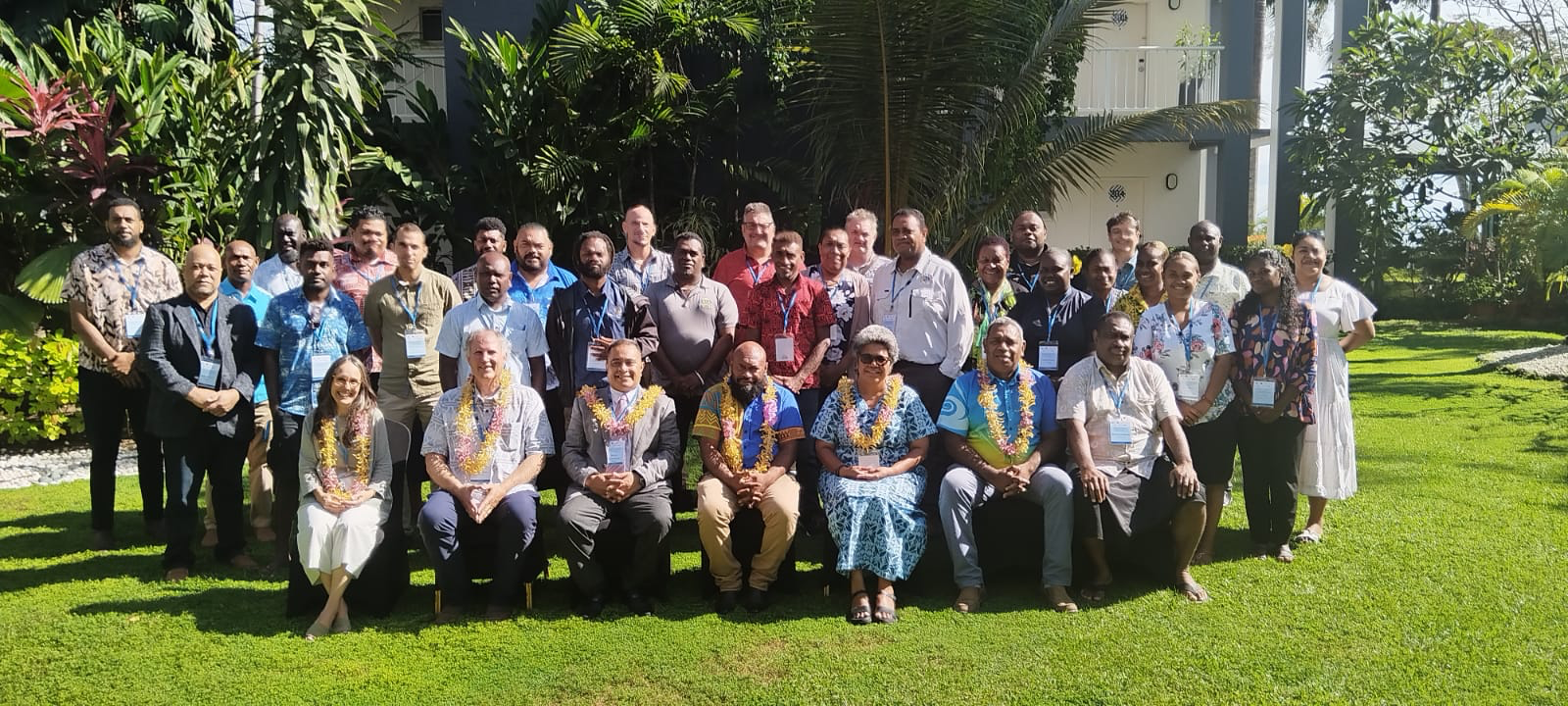
Minister Manuari (c) and delegates to the Regional Geo-Hazards Meeting in Honiara
[ENDS]