

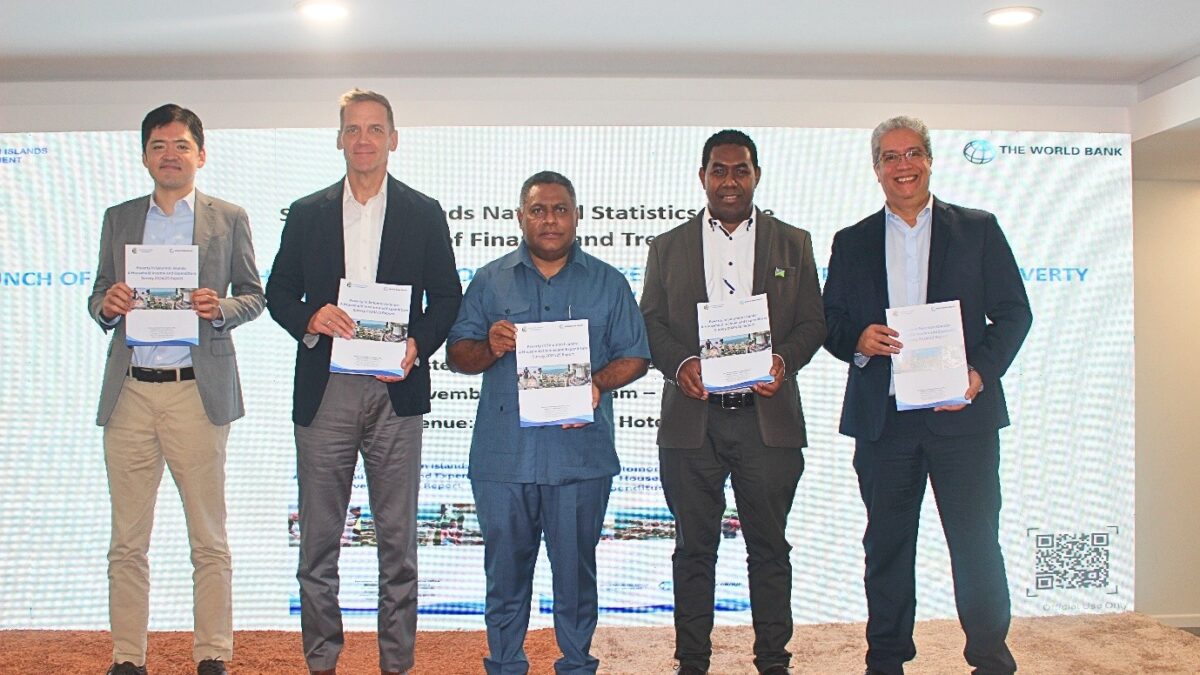
Left to right; World Bank Senior Economist in Poverty Global Department Shohei Nakamura, World Bank Resident Representative for Solomon Islands Bernard Harborne, Minister Finance and Treasury Rexon Ramofafia, Government Statistician Samson Kanamoli and Finance and Treasury Permanent Secretary David Dennis.
HIES 2024-2025 AND POVERTY REPORTS LAUNCHED BY MINISTER Hon. Rexon Ramofafia
The 2024-25 Household Income and Expenditure Survey (HIES), and the Poverty Analysis Reports and key findings have been officially launched and released by the Minister of Finance and Treasury Hon. Rexon Ramofafia last week Friday on 13th November 2026 at the Heritage Hotel in Honiara.
The government through the Solomon Islands National Statistics Office (SINSO), Ministry of Finance and Treasury in partnership with the World Bank have successfully implemented the HIES late last year, completed the analyses and have now disseminated these reports and key findings.
The HIES 2024/2025 report include statistics on population and household characteristics, education, labor force participation, employment, housing conditions, household consumption including food consumption, household income, and selected Sustainable Development Goal (SDG) indicators.
The Poverty Analysis report is derived from the HIES and provides the first nationally representative assessment of poverty and living standards in Solomon Islands in more than a decade.
Minister Honourable Ramofafia congratulated SINSO and the World Bank for the reports saying evidence-based decision is essential.
“We cannot effectively plan for our people’s future without understanding their current circumstances and challenges.
“These findings will guide the government’s policy statement for next year’s priorities which includes the free education, decentralisation and inclusive governance, renewable energy to cut tariffs, universal healthcare and the 2027 budget strategy, medium term-development strategy and national development plan.”
The Government Statistician Samson Kanamoli briefly explained the process undertaken during the implementation of the HIES.
He explained the design and implementation of the 2024/2025 HIES from past HIES, therefore caution should be taken in any direct comparison of results and analysis.
Mr Kanamoli said despite challenges and setbacks encountered during the implementation of the survey, it was successfully undertaken with a response rate of 99.6 percent.
“The data before you is not simply numbers, it is the story of our people’s lives, their challenges, their hope.”
The HIES 2024/2025 report showed that the total annual household consumption amounted to SBD 16.1 billion, with spending highly concentrated in a few categories. The two most significant categories was food and non-alcoholic beverages, accounting for the largest share of consumption at SBD 6.8 billion (42.2 percent), followed by housing at SBD 3.4 billion (20.8 percent).
The most consumed food groups in the Solomon Islands was cereals, roots and tubers, fish and shellfish, fruits, and composite dishes. However, there are substantial differences in household food consumption across urban and rural areas, and provinces. Urban households are consuming considerably more fish, meat, and composite dishes than rural households, while rural households consume more roots and tubers and pulses
Meanwhile, the Poverty report presented that an estimated 40.4 percent of the population in Solomon Islands live below the national poverty line, while 25.2 percent lives below the food poverty line. Approximately 322,500 people are estimated to be living in poverty nationwide.
Living standards vary substantially across locations and population groups. Consumption levels are generally higher in Honiara and Guadalcanal than in other parts of the country, while poverty rates are highest in Malaita, Western, and Temotu Provinces.
However, several indicators of living standards have improved over the past fifteen years. The proportion of people living in housing constructed with inadequate materials has declined, access to sanitation has expanded, and ownership of mobile phones has increased rapidly.
The HIES 2024/2025 was conducted over a twelve-month period covering a total of more than four thousand selected households through-out the country.
A total of 99.6 percent responded favourably in the survey requirements.
This HIES has evolved over the past decades since the implementation of the first HIES in 1992, with the current HIES being the fourth one and one that provides updated information on household consumption and income patterns as well as a broad range of demographic, social, labor, housing, and agricultural characteristics.
World Bank partnered with the Solomon Islands National Statistics Office for the HIES 2024/2025 on behalf of the national government and successfully completed the survey in November 2025.
Copies of the reports are available to download on the Solomon Islands National Statistics Website.
ENDS.///