

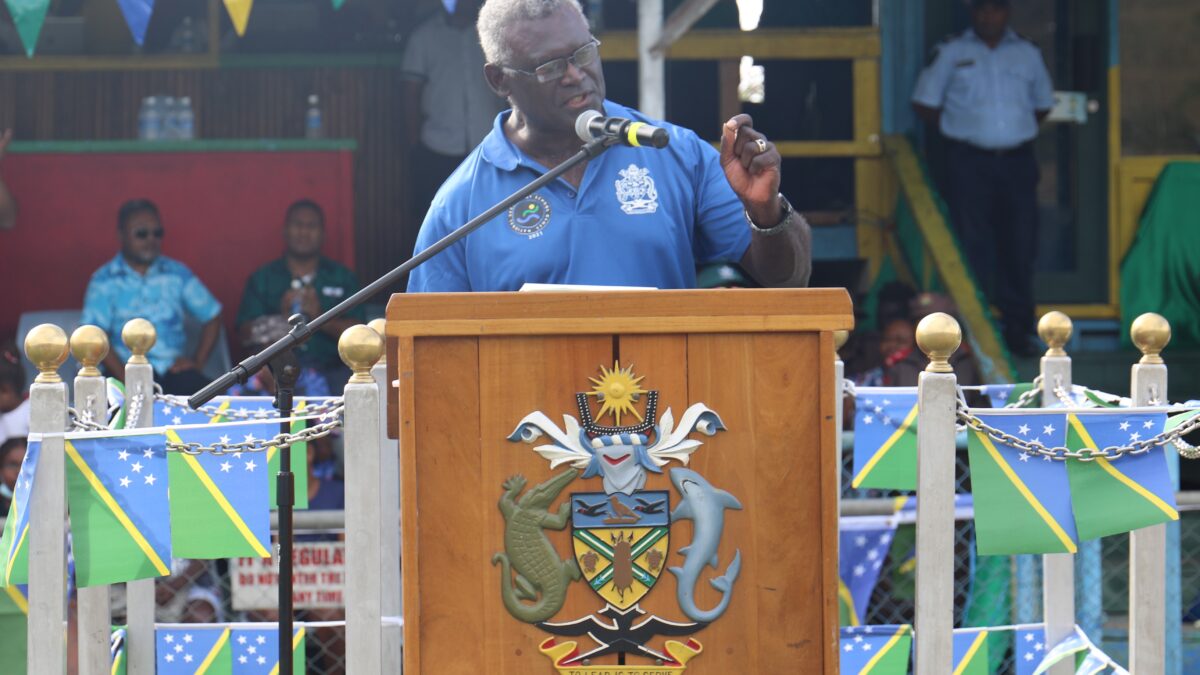
Prime Minister Sogavare says infrastructure is an important enabler of development.
DCGA committed to progressing game-changing infrastructures: PM
PRIME Minister Manasseh Sogavare says infrastructure is an important enabler of development.
The Prime Minister in his recent 2021 Independence Address said investments in infrastructure generate multiplier effects in other sectors and throughout the economy.
Prime Minister Sogavare said infrastructure links people to markets and services, supports and stimulates economic activities in rural areas and brings about improvements in the livelihoods of our people.
“Infrastructure development remains an important priority of the Government. The Government remains committed to progressing key game changing infrastructure initiatives that have the potential to drive transformative change and boost economic and social development,” he said.
The Prime Minister also reiterated what he stated in his 2019 Independence Address, which ‘calls for innovative approaches to infrastructure planning and development that not only address social and economic constraints but one that demonstrates inclusivity and a whole of country focus’.
Prime Minister Sogavare said despite the COVID-19 global pandemic, we have made some progress on that front.
“I am glad to update you all that a concept study desktop analysis of the National Transport Core Initiative was undertaken. The concept study assessed the technical, economic, environmental and social viability of the National Transport Core Initiative,” he said.
Infrastructure development remains an important priority of the Government. The Government remains committed to progressing key game changing infrastructure initiatives that have the potential to drive transformative change and boost economic and social development
The Prime Minister highlighted that the key findings were:
- First, the overall National Transport Core Initiative will generate significant benefits and to deliver it, the costs would be substantial. The overall capital investment of the configuration is estimated at US$855m, with 85% of the total costs being for roads and bridges, while 6% relates to port infrastructure and 9% associated with the vessels.
- Second, the domestic shipping environment in Solomon Islands is sub-optimal and unsafe, and as such, the National Transport Core Initiative objectives of consolidating inter-island transport would improve this situation.
- Third, there is potential for private sector participation, in the ownership, construction, operation and maintenance for both port infrastructure and vessels. The vessels servicing the sea bridges could be delivered via a public-private partnership
- Fourth, National Transport Core Initiatives benefits were derived from vessel operating cost reductions, travel time savings, reduced damage and loss of freight, generated traffic, travel safety benefits, health benefits and associated lowered mortality rates.
- Fifth, the overall program will generate significant benefits to the populations of Malaita, Guadalcanal and New Georgia through the provision of upgraded roads and sea bridges. It will lower both import and export costs for agriculture producers and consumers within the islands.
- Sixth, the economic impact assessment found that the introduction of the National Transport Core Initiative could lead to an increased in agricultural production and reductions in the loss or damage of cargo. These impacts could translate to an increase in the value of production across the three target provinces estimated at $6.4million per year or equivalent to 2747 rural jobs.
- Seventh, the reductions in the vessel and overland transportation costs could have a flow through impact on the costs of goods for purchase, assuming that all cost savings are passed through the market to the end customer. These savings would be significant in Malaita and Western provinces, estimated at about 9.9% and 86 % of income respectively.
- Eight, the NTCI will contribute to reductions in both cost and time, and therefore has the potential to reduce some of the barriers to accessing social services such as health and education.
Prime Minister Sogavare said the next step is to do a study, which would cover the following;
- hinterland assessment and traffic surveys, virtual sea-bridge ownership and operating entity;
- field engineering investigations and validation of desktop engineering designs;
- field consultations with selected communities;
- revalidation of economic assessment; and
- update of the National Transport Core Initiative concept.
The Prime Minister also highlighted that the Solomon Islands Government and the Australian Government had just signed a Subsidiary Agreement worth $AUD250 million for 10 years under the broader Solomon Islands Infrastructure Program.
He said two components of the National Transport Core Initiative have been taken up as part of the start-up work-plan under this agreement.
“These are the technical preparatory work on the Bina Harbour Project and the planned Noro Port redevelopment project that would potentially leverage additional financing from the Australian Infrastructure Investment Financing Facility (AIFFP),” he said.
Prime Minister Sogavare said the Solomon Islands Infrastructure Program initial start-up work-plan will include activities aimed at strengthening infrastructure policy, planning and management and infrastructure financing and delivery.
“Key infrastructure policy work will include support for the finalization of the Solomon Islands Infrastructure Management Bill and Building Codes,” he said.
The Prime Minister said work is also underway to establish a National Infrastructure Development Authority.
“Initial baseline gathering work for the infrastructure sector will lead to a repository of infrastructure information, materials and knowledge for Solomon Islands,” he said.
GCU Press