

Solomon Islands Strengthens National Capacity for Greenhouse Gas Reporting and Climate Transparency
TAMBOKO, GUADALCANAL, Solomon Islands — 19 October 2026
The Ministry of Environment, Climate Change, Disaster Management and Meteorology (MECDM), in partnership with the Capacity Building for Transparency (CBIT) Project is strengthening national capacity for greenhouse gas (GHG) emissions reporting and climate transparency through a five-day training workshop held at Ginger Beach Retreat, Tamboko, Northwest Guadalcanal, from 19 to 23 October 2026.
The training is conducted under the Global Environment Facility (GEF)-funded Capacity-Building Initiative for Transparency (CBIT) project and is facilitated by the CBIT Project Technical Assistant Dr Gyanendra Karki and the Climate Change Division (CCD) within MECDM.
The workshop was officially opened with remarks from Thaddeus Siota, Director of the Climate Change Division, who highlighted the importance of strengthening national capacity and coordination to improve greenhouse gas inventory preparation and climate reporting in Solomon Islands.
‘I would like to thank all participants for taking the time to attend this important training. Your participation, commitment and willingness to learn are essential to strengthening our national capacity for greenhouse gas inventory preparation and climate transparency. I encourage everyone to make the most of this opportunity and apply the knowledge gained to support our country’s climate change commitments,’ he said.”
The training aims to equip government officials, technical experts and relevant stakeholders with practical knowledge and skills to prepare a comprehensive and accurate national GHG inventory for Solomon Islands’ Second Biennial Transparency Report (BTR2), in line with the Enhanced Transparency Framework (ETF) under the Paris Agreement.
Building on the country’s submission of its First Biennial Transparency Report (BTR1), the workshop addresses identified gaps in emissions data collection, data management, quality assurance and reporting. Strengthening these areas is essential to improving the reliability of national climate information and supporting evidence-based climate policy and decision-making.
Participants are receiving practical training in the application of the Intergovernmental Panel on Climate Change (IPCC) 2006 Guidelines for National Greenhouse Gas Inventories and the use of IPCC Inventory Software. The training covers five key inventory sectors: Energy, Industrial Processes and Product Use (IPPU), Agriculture, Land Use, Land-Use Change and Forestry (LULUCF), and Waste.
Sessions also focus on improving data quality, completing standardised reporting tables, identifying information gaps and developing sector-specific improvement plans to support future reporting requirements.
The workshop brings together stakeholders from relevant government ministries, technical agencies, academic institutions and civil society, recognising the importance of inter-agency collaboration and information-sharing in strengthening the country’s national climate transparency system.
Through this initiative, MECDM and the CBIT Project Team are supporting Solomon Islands to improve its capacity to monitor greenhouse gas emissions and removals, track progress towards its Nationally Determined Contribution (NDC) commitments, and meet its international climate reporting obligations under the Paris Agreement.
The training represents an important step towards strengthening national systems, technical expertise and institutional coordination for more transparent and effective climate action in Solomon Islands.
ENDS
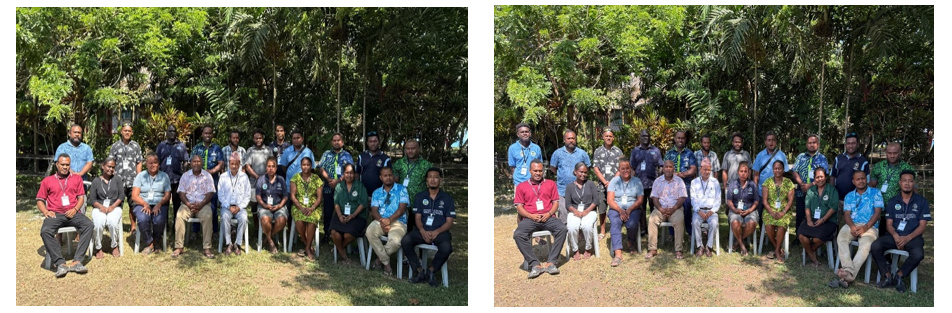
Caption: Group photo featuring the Director of the Climate Change Division Thaddeus Siota (CCD), MECDM, alongside officials from MECDM, CBIT and various government ministries participating in the National Greenhouse Gas Inventory and Enhanced Transparency Framework (ETF) Capacity-Building Training Workshop at Ginger Beach Retreat, Tamboko, Guadalcanal.