

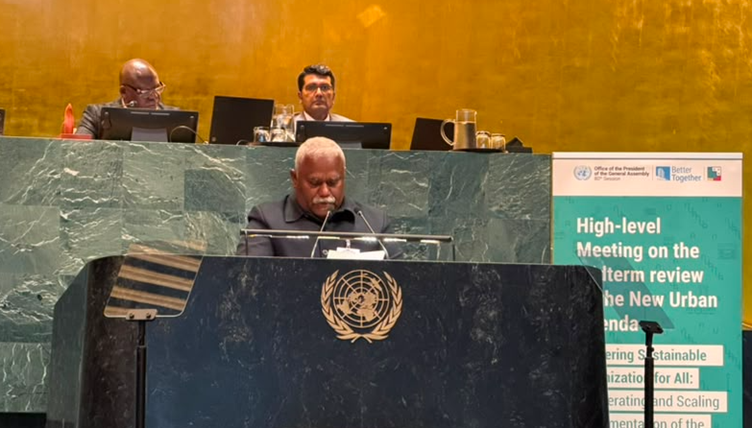
Minister for Lands, Hon. Oliver Salopuka, during his address to the UN High-level Meeting on mid-term review of New Urban Agenda
Solomon Islands Reaffirms Commitment to Sustainable Cities at UN High-Level Meeting
The Hon. Oliver Salopuka, Minister for the Ministry of Lands, Housing and Survey, delivered a pressing call for sustainable urban development and climate resilience during the High-level Meeting on the Midterm Review of the New Urban Agenda.
In his address to the UN General Assembly, Minister Salopuka reaffirmed Solomon Islands’ dedication to the New Urban Agenda and the 2030 Agenda for Sustainable Development, noting that this shared vision is deeply embedded in the nation’s National Development Strategy (NDS 2016–2035).
While acknowledging that the Solomon Islands remains predominantly rural, the Minister highlighted a critical demographic shift. Driven by a high population growth rate of 3 percent and a youthful demographic in which 70 percent of the population is under 29, the nation is experiencing rapid, unplanned urban expansion. This growth is most notable in Honiara and emerging provincial centers, presenting economic opportunities but also placing immense strain on housing, infrastructure, and public services, which has led to the complex growth of informal settlements.
Compounding these urbanization challenges is the existential threat of climate change. Minister Salopuka warned that rising sea levels, frequent coastal flooding, and extreme weather events are actively reshaping the future of the nation’s towns and threatening critical infrastructure.
“These realities reinforce the need to integrate climate resilience into every aspect of urban planning and development,” he stated.
To manage these challenges, the government has implemented the Solomon Islands Urban Policy and aligned it with the National Disaster Management policy to construct climate and disaster-resilient towns. These coordinated national efforts have yielded significant progress: today, more than 93 percent of Solomon Islanders in urban areas have access to improved drinking water, and over 81 percent have access to improved sanitation.
The Minister also showcased several transformative infrastructure investments driving the nation forward. These include the Tina River Hydropower Project, which aims to provide affordable electricity and support the transition to renewable energy, and the Solomon Islands National Broadband Infrastructure Project (SINBIP). Building on the Coral Sea Cable System, the SINBIP is currently deploying a massive network of 161 telecommunications towers to transform digital connectivity across the islands.
Addressing the broader societal impacts of urbanization, Salopuka emphasized the need for inclusive, people-centered development that gives a voice to women, young people, persons with disabilities, and customary landowners. He noted that solving the challenges of informal settlements requires an integrated and interconnected approach that includes secure land tenure and affordable housing, while also emphasizing that improving rural living standards is equally crucial to curb the poverty driving urban migration.
Minister Salopuka issued a strong call to the international community for enhanced cooperation under SDG17. He outlined specific needs for Small Island Developing States (SIDS), including increased access to climate and urban development finance to close existing gaps, capacity building in governance, and support for nature-based solutions and resilient infrastructure.
The Minister declared, “We stand ready to work with all Member States, UN-Habitat and our development partners to translate our shared commitments into meaningful action that improves the lives of our people and safeguards the future of our communities.
The End.