

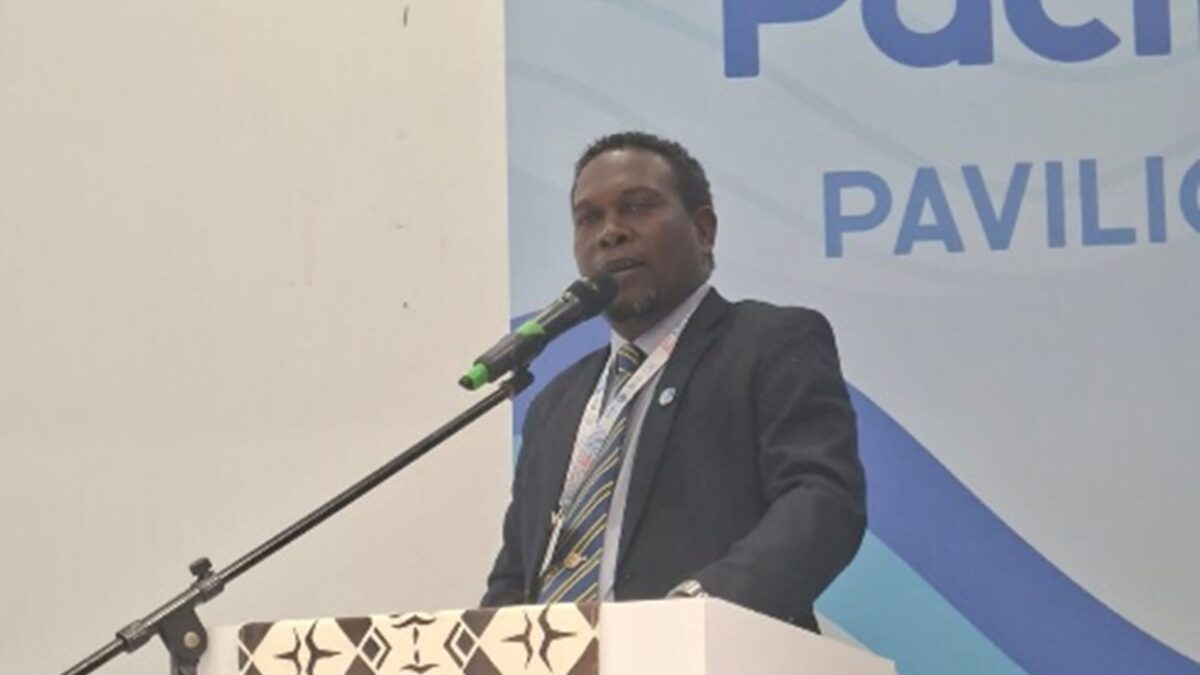
SOLOMON ISLANDS CALLS FOR FASTER AND MORE ACCESSIBLE CLIMATE FINANCE FOR PACIFIC COMMUNITIES
Solomon Islands has called for faster, more accessible and coordinated climate and disaster financing to ensure vulnerable Pacific communities receive the support they need before, during and after climate-related disasters.
The call was made by the Minister for Environment, Climate Change, Disaster Management and Meteorology, Hon. Wayne Ghemu, during his keynote address at the Pacific Catastrophe Risk Insurance Company (PCRIC) COP31 side event, titled “Finance That Reaches the Pacific: Connecting Loss and Damage, Global Support and Regional Delivery,” in Antalya, Türkiye, on Tuesday, 10 November 2026.
Drawing on Solomon Islands’ experience with Severe Tropical Cyclone Maila in April 2026, Minister Ghemu highlighted the importance of timely financing in supporting disaster response and recovery. Maila reached Category 5 intensity and severely affected communities in Western Province, particularly Simbo Island, where approximately 2,247 people were affected, 268 displaced and groundwater sources contaminated.
The Minister highlighted the USD 500,000 payout from PCRIC to the Solomon Islands Government on 23 April 2026, which helped offset emergency relief expenditure.
“Cyclone Maila demonstrated the value of having pre-arranged financing available when our people and governments need it most. The same amount of funding can have a very different impact depending on when it arrives and what it is used for,” Minister Ghemu said.
He also highlighted Solomon Islands’ National Disaster Risk Financing Strategy 2024–2027, which adopts a layered approach involving contingency funds, emergency reserves, contingent credit and sovereign insurance. At community level, the Central Bank’s TrigaCash microinsurance also demonstrated the value of accessible financial protection, paying 35 policyholders affected by January 2026 rainfall within two weeks.
Connecting regional and global financing mechanisms
Minister Ghemu emphasised the complementary roles of four important mechanisms: the Fund for Responding to Loss and Damage (FRLD), Global Shield against Climate Risks, Pacific Resilience Facility (PRF) and PCRIC.
He explained that the Global Shield supports pre-arranged financial protection, including insurance premium affordability through PCRIC, while the PRF provides grant financing to strengthen community resilience and reduce future climate and disaster risks. PCRIC provides rapid financial liquidity following eligible disasters, as demonstrated by its Cyclone Maila payout.
The Minister reaffirmed Solomon Islands’ commitment to the PRF, noting that the country hosted the signing of its Treaty in Honiara in September 2025, ratified it in January 2026 and pledged USD 1 million towards the regional facility.
He further expressed hope that the FRLD would provide a dependable financing pathway for longer-term recovery and reconstruction, particularly for communities experiencing loss and damage to homes, essential infrastructure, water systems and livelihoods.
A call to accelerate access to climate finance
The Minister raised concerns about lengthy international climate finance processes, including accreditation, project preparation and complex approval requirements, warning that delays increase recovery costs and place additional pressure on national budgets and development priorities.
“By the time funding is approved, the cyclone has passed, costs have increased, and the needs of our communities may have changed. Finance that arrives after the moment of need risks missing its purpose,” he emphasised.
He also highlighted Solomon Islands’ efforts to strengthen national disaster preparedness and response systems, including humanitarian warehouses in Honiara and Auki to improve the delivery of emergency supplies to remote and maritime communities.
With the Pacific entering its cyclone season, Minister Ghemu called on international financial institutions and regional mechanisms to simplify access requirements, accelerate funding approvals and disbursements, and strengthen coordination to ensure resources reach vulnerable communities when they are needed most.
He concluded by urging the FRLD, Global Shield, PRF, PCRIC and international financial institutions to work together to deliver predictable, accessible and timely financing for Pacific Island countries.
“Let us simplify, speed up and agree on how our financing mechanisms work together before the next cyclone, and not after it. Cyclone Maila showed that timely financing can make a difference. Let us make this the normal way the Pacific is supported, and not the exception,” Minister Ghemu said.
ENDS