

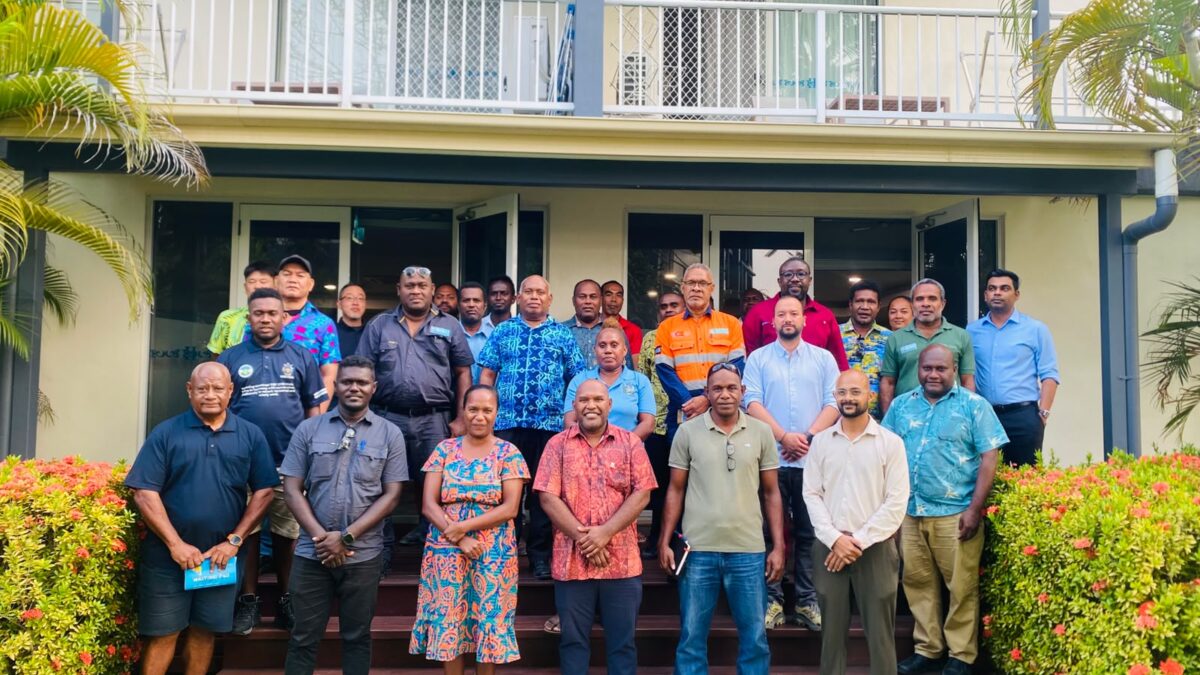
Group photo of those who attend the Solomon Islands Electric Mobility Workshop with Climate Change Division Director Mr. Thaddeus Siota in the centre
Solomon Islands Advances Electric Mobility with Capacity Building and National Standards
Honiara, Solomon Islands, 23 September 2026 – Solomon Islands has taken another practical step towards low- and zero-emission transport, bringing together government, the private sector, civil society and development partners to strengthen national capacity and begin developing standards for electric vehicles and charging equipment.
The workshop was convened by the Ministry of Environment, Climate Change, Disaster Management and Meteorology (MECDM) and the Global Green Growth Institute (GGGI) under the project, Transformation to Low/Zero Emissions Transport Sector – Enabling Uptake of Electric Mobility in Solomon Islands. The project is supported by the Global Environment Facility (GEF), implemented by the United Nations Environment Programme (UNEP), and executed by MECDM with technical support from GGGI.
Building on the project inception workshop held in March and the first Project Steering Committee meeting in May, the event marked a shift from project establishment to technical implementation.
Representatives participating through the Inter-Sectoral Coordination Platform strengthened their understanding of sustainable transport and electric mobility and began assessing existing technical, institutional and coordination capacities. The findings will help identify priority knowledge gaps and shape further training for the institutions responsible for guiding the transition.
The workshop also launched the process of developing minimum standards for electric vehicles (EVs) and electric vehicle supply equipment (EVSE), together with the technical requirements and implementation tools needed to put those standards into practice.
The standards will help ensure that vehicles and chargers entering and operating in Solomon Islands are safe, reliable, compatible and suited to local conditions. They will also give government agencies a consistent basis for inspection, registration and installation while providing greater clarity for importers, investors and consumers.
Director Climate Change MECDM, Mr. Thaddeus Siota, emphasized that electric mobility requires a coordinated system of support.
“Electric mobility is not simply about replacing conventional vehicles with electric vehicles. It requires the appropriate policies, standards, infrastructure, skills, institutions and systems to support its safe and effective development,” he said.
Electric mobility involves responsibilities across transport, energy, environment, infrastructure, trade, customs, finance, standards and urban planning. The workshop therefore brought these perspectives together at the outset, helping institutions clarify their roles and identify practical issues that the standards and future capacity-building activities must address.
The need for action is closely linked to Solomon Islands’ exposure to imported fuel. The country’s Long-Term Low Emissions Development Strategy estimates that land transport uses close to 60 million litres of diesel and 40 million litres of petrol each year – approximately 100 million litres of imported fuel to keep vehicles moving on the country’s roads.
GGGI Pacific Regional Director Ratu Sakiusa Tuisolia said standards are among the first practical foundations needed to reduce this exposure over time and allow the electric mobility market to develop responsibly.
“People need to know that a vehicle is safe to drive and a charger is safe to use. Importers and investors need clear requirements. Government agencies need a consistent basis for inspection, registration and installation. If we get these foundations right, we can give the market confidence to grow responsibly,” he said.
Electric vehicles displayed during the event connected the technical discussions with products already present in the Solomon Islands market. Participants were able to examine the vehicles and consider how international and regional experience should be adapted to the country’s roads, climate, electricity system, import markets and institutional capacity.
The standards development process will continue through benchmarking, technical assessment and stakeholder consultation. Inputs from government agencies, vehicle suppliers, electricity and charging stakeholders, technical service providers and other partners will be important in ensuring that the resulting requirements are both robust and practical to implement.
Through this work, Solomon Islands is building the institutional and regulatory foundations for a safer, more resilient and lower-emission transport system that can reduce dependence on imported petroleum over time and support the country’s climate and sustainable-development priorities.