

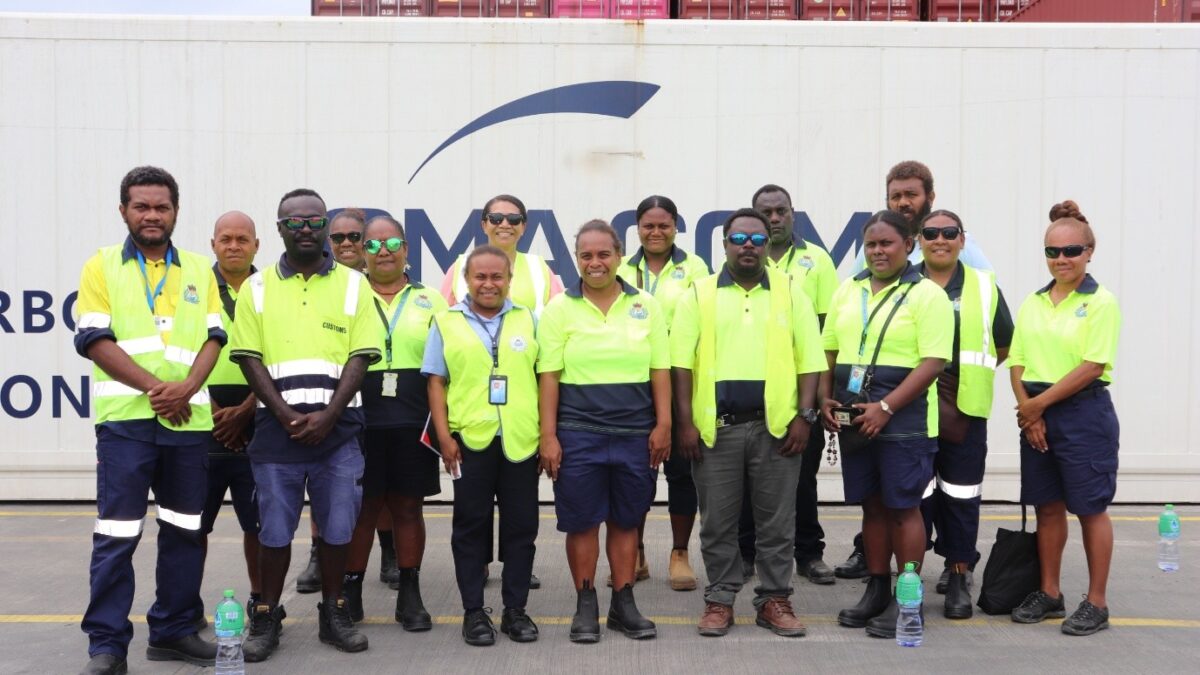
Group photo of training participants and facilitator after the seaport physical inspection practical activity of Reefer Containers at the Solomon Ports Container Terminal in Honiara.
Honiara, Solomon Islands – September 20, 2026.
The Solomon Islands Customs and Excise Division (SICED) has strengthened the capacity of its officers in customs risk management, intelligence-led targeting and border control through the World Customs Organization (WCO) – United Nations Office on Drugs and Crime (UNODC) Passenger and Cargo Control Programme: Risk Management and Practical Training.
The training forms part of ongoing efforts to strengthen Solomon Islands Customs’ ability to identify, assess and respond to high-risk consignments while facilitating legitimate trade and making effective use of available resources.
WCO Technical Expert and trainer Akosita Valamalua highlighted that, with increasing volumes of international trade and limited resources to physically inspect every imported container, risk management provides Customs administrations with an important framework for determining where controls and interventions should be focused.
“The WCO recognises risk management as a guiding principle of modern Customs administration, supporting administrations to concentrate control resources on higher-risk movements while facilitating legitimate, lower-risk trade.
“The training placed strong emphasis on the practical application of risk management and reinforced that effective risk management is a shared responsibility across Customs administration.
“Customs officers actively participated in the analysis of import trade data, group discussions, presentations, and practical exercises designed to strengthen their understanding of risk identification, assessment, profiling, and targeting,” trainer Akosita Valamalua said.
“Effective risk management also supports the broader objective of balancing trade facilitation, compliance, resource optimisation and border security,” Valamalua added.
Key practical activities included:
• Drafting Standard Operating Procedures (SOPs) for the proposed Port Control Unit;
• Developing profile report management templates;
• Identifying and defining appropriate risk profile criteria;
• Exploring the use of ASYCUDA World to support risk profiling and targeting; and
• Applying risk management principles to real operational challenges faced by Customs.
The WCO Customs Risk Management Compendium identifies risk assessment, profiling and targeting as important components of modern Customs control and supports administrations in developing structured approaches to identifying high-risk consignments, passengers and conveyances.
Strengthening the Port Control Unit
Participants were drawn from a range of Customs functions, reflecting the cross-functional nature of the work required to establish and strengthen the Port Control Unit in Honiara. The involvement of officers from different Customs functions is important to ensuring that risk information, intelligence, targeting and operational controls are connected across the organisation.
The training also provided an opportunity for participants to identify existing gaps and challenges and consider practical approaches for strengthening Customs procedures and coordination.
Responding to Emerging Transnational Crime Risks
The movement of illicit drugs and other high-risk goods through international supply chains presents an ongoing challenge for Customs and other border-control agencies across the Pacific.
For Solomon Islands, strengthening intelligence-led risk management and targeting capabilities is an important component of preparedness as transnational crime threats continue to evolve.
Through the WCO–UNODC Passenger and Cargo Control Programme, Customs officers have gained practical knowledge and skills to better identify and target high-risk goods and movements, while supporting efficient clearance of legitimate trade.
The WCO notes that intelligence-supported risk management enables Customs administrations to make more informed decisions and focus limited resources on risks of greatest consequence.
Building Stronger Partnerships
The training also highlights the importance of cooperation and information sharing between Customs administrations, national border agencies and international partners.
For Solomon Islands Customs, continued engagement with regional and international partners is important to strengthening technical capacity, sharing intelligence and improving operational responses to emerging threats.
SICED acknowledges that effective border protection requires a coordinated approach involving Customs and relevant national and international stakeholders.
Acknowledgement and Appreciation.
The Solomon Islands Customs and Excise Division sincerely acknowledges the organisations and partners whose support contributed to the successful delivery of the training initiative:
• World Customs Organization (WCO);
• United Nations Office on Drugs and Crime (UNODC);
• Australian Border Force (ABF); and
• Solomon Islands Customs Administration.
SICED recognises the valuable contribution of these partners to strengthening Customs capacity and supporting the development of modern, intelligence-led border management practices in the Solomon Islands.
Looking Ahead
The completion of the training represents an important step in strengthening Solomon Islands Customs’ risk management and targeting capabilities.
SICED will continue to work towards embedding risk management into its operational practices, strengthening the use of Customs data and intelligence, improving risk profiling and targeting, and supporting the development of the Port Control Unit.
These efforts are aimed at ensuring that Solomon Islands Customs remains responsive to emerging border risks while continuing to support legitimate trade and the movement of goods through the country’s borders.
ENDS///
– SICED PRESS
With Photos
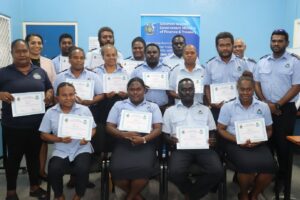
Training participants posed for a group photo with the Customs Executives and WCO Trainer (far left) with their official Certificates after the training.
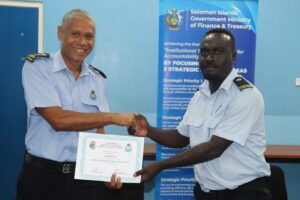
Customs officer Goodnews Voda, who worked at the Noro Ports container examination facility in Western Province Outports, posed with his certificate after receiving it from the Customs Comptroller, John Peter Lagi.
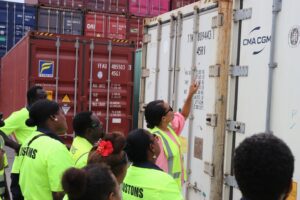
Customs officers learn how to read the gross and tare weight of containers during the practical inspection session.
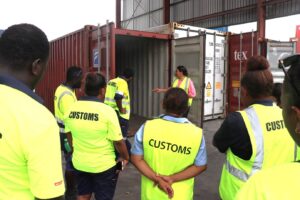
Officers train on how to physically examine a Cargo container and how to identify types of prohibited concealment and storage risks of containers.
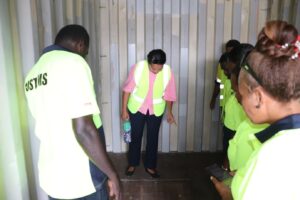
Officers train on how to physically examine a Cargo container and how to identify types of prohibited concealment and storage risks of containers.
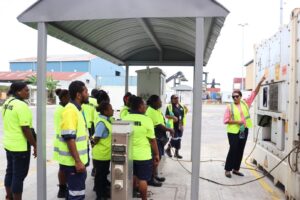
WCO Expert Valamalua explains to the trainees the types and components of another Reefer containers at the Solomon Ports Container Storage facility.
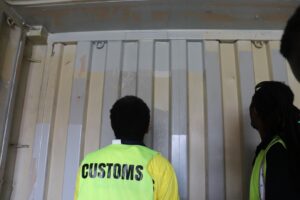
As part of the Inspection training, Customs officers physically inspect the inside of a Cargo container.
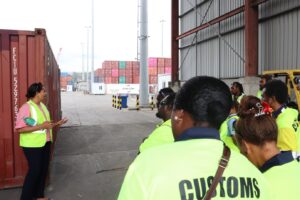
WCO Trainer explains to the trainees how to unlock, inspect, and seal Reefer containers prior to inspection.