

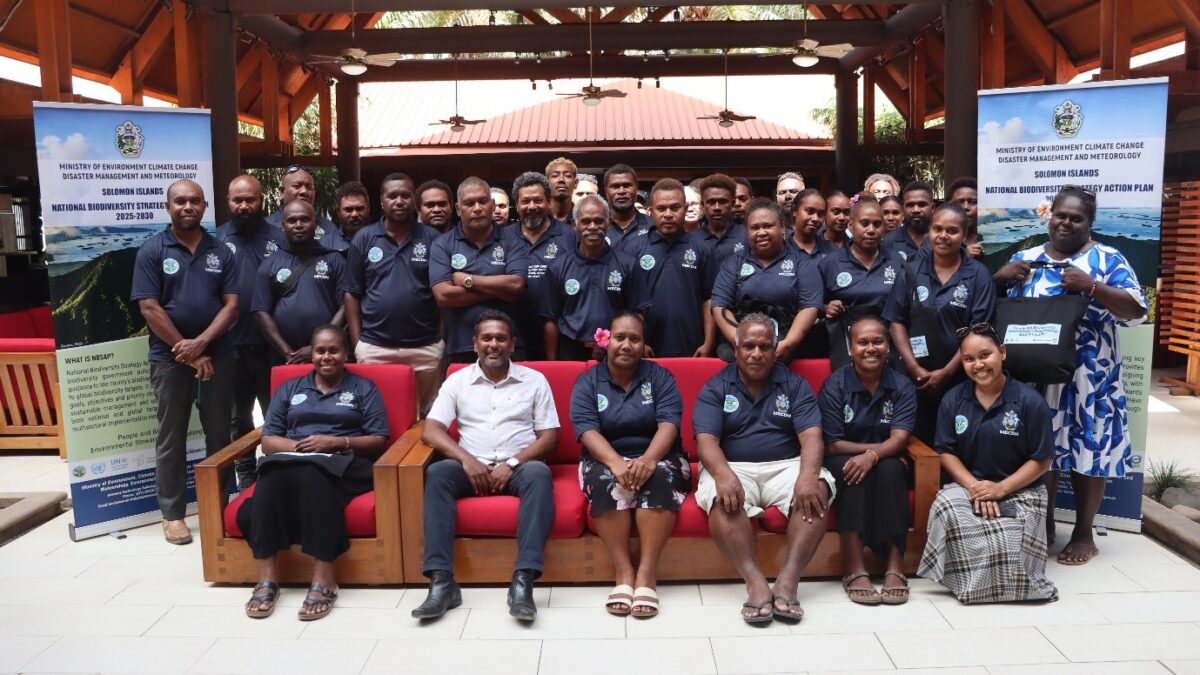
(Photo: MECDM staff pose for a group photo after the workshop at Mendana Hotel)
MECDM Commences Review and Consultation on Solomon Islands National Biodiversity Strategy and Action Plan
Honiara, Solomon Islands — Staff of the Ministry of Environment, Climate Change, Disaster Management and Meteorology (MECDM), representing all divisions, gathered in Honiara last week for an internal consultation workshop to review and update the Solomon Islands National Biodiversity Strategy and Action Plan (NBSAP).
The workshop marked an important step in updating the country’s biodiversity framework, which previously covered the period 2016–2020, to align with the Kunming-Montreal Global Biodiversity Framework (GBF).
Led by the Environment and Conservation Division (ECD), the internal consultation aimed to assess progress, identify implementation gaps, and set ambitious national targets for 2030 and beyond. This internal alignment is critical as Solomon Islands prepares to implement activities to achieve its national biodiversity targets and contribute to global biodiversity goals.
Key objectives of the consultation included:
- Progress assessment: Reviewing the effectiveness of past conservation actions and the integration of biodiversity considerations across government sectors.
- Global alignment: Ensuring national targets reflect the ambition of the GBF, including the “30 by 30” target of protecting 30 percent of land and sea by 2030.
- Internal synergy: Strengthening collaboration between MECDM technical divisions, including Climate Change, Meteorology and National Disaster Management, to support a whole-of-ministry approach to environmental management.
- Strategy finalisation: Refining the draft Solomon Islands NBSAP 2026 ahead of broader provincial and stakeholder consultations.
Speaking during the workshop on behalf of the Permanent Secretary of MECDM, Deputy Secretary Corporate, Mr. Karl Kuper, emphasised that the NBSAP is not just a policy document, but a roadmap for cross-sectoral action.
He said the strategy provides guidance on how stakeholders can work together to conserve and promote the country’s biodiversity through the sustainable management and use of natural resources, ensuring that future generations of Solomon Islanders continue to benefit from them.
Mr. Kuper further highlighted that the workshop was an important part of the Ministry’s review process, as staff from the different technical and corporate divisions, together with oversight committee members, were able to review and provide feedback on the new draft NBSAP 2026.
He said discussions focused particularly on the NBSAP thematic areas, national targets and strategic actions, as well as challenges, issues and priority actions relevant to the mandates of the respective divisions and departments.
The outcomes of the workshop will directly inform the final draft of the updated NBSAP, which will undergo further validation with provincial governments and community partners to ensure local ownership and culturally grounded solutions.
The consultation process will continue with relevant partners, including government ministries, provincial governments, non-government organisations, community-based organisations, the private sector, developers and development partners.
MECDM calls on all partners working in the biodiversity and environment sectors to participate and contribute to the process, as the NBSAP is an important Government policy document that provides guidance for biodiversity conservation and management in Solomon Islands.
ENDS///
MECDM Press