

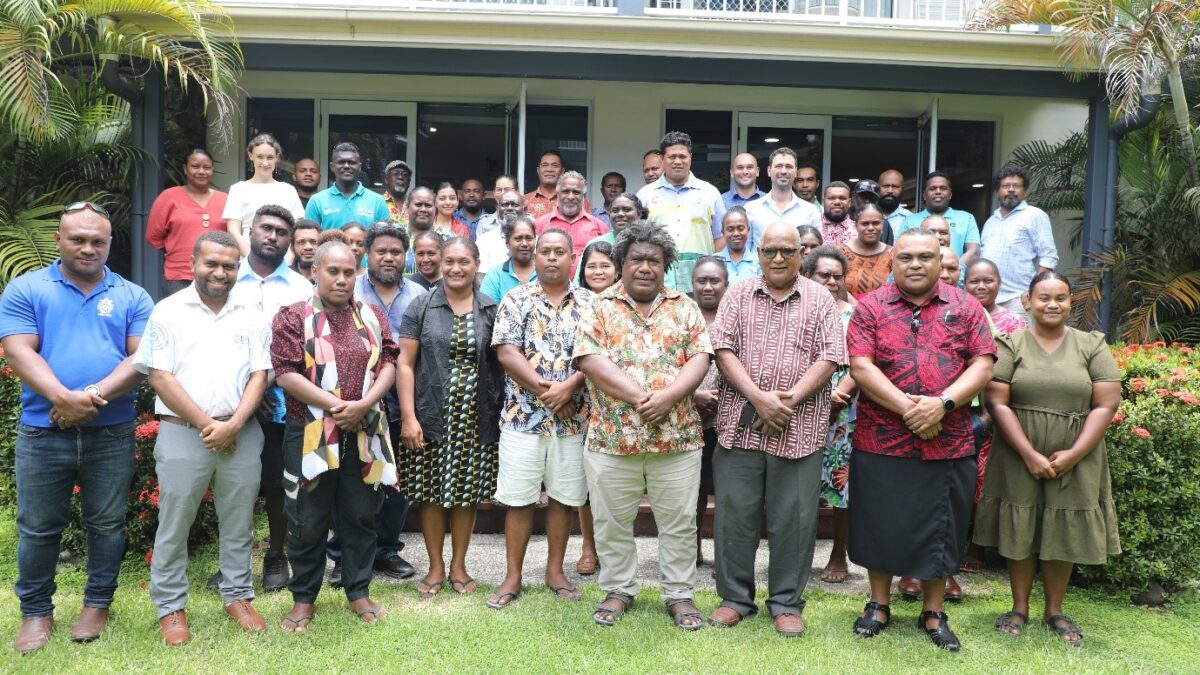
(Group photo: MECDM Permanent Secretary Mr. David Hiriasia (centre), with representatives from our Development partners, SOEs, NGOs, CSOs, Private Sectors, Academia and senior officials from the various Government ministries).
MECDM: CLIMATE CHANGE DIVISION ROUNDTABLE DISCUSSION
The Ministry of Environment Climate Change Disaster Management and Meteorology (MECDM) under the Climate Change Division conclude one day roundtable discussion with the other line Ministries, Private sectors, Donor partners, NGOs, CSOs and other Tertiary institution at the Heritage Park Hotel.
The Climate Change Roundtable (CCR) is designed to serve as a platform for genuine dialogue, coordination and collaboration among all stakeholders. It aligns partner support with the national priorities and promotes transparency, accountability and mutual learning.
This year’s first meeting, its objectives are to recap on the roundtable structure and expectations, review the Climate Change Division’s strategic priorities and upcoming events, hear updates from each other and identify practical opportunities for coordination and agree on next steps and meeting dates.
Speaking during the discussion MECDM Permanent Secretary Mr. David Hiba Hiriasia said the roundtable discussion is an important moment for us. As outlined in the Solomon Islands National Climate Change Policy, climate action cannot and must not be carried out by government alone. The Policy calls explicitly for ministries, the private sector, donor partners NGOs and communities to work together. The gathering today is a practical expression of all call for collective action Hiriasia stated.
Hiriasia also stated that as we know too well, climate change is the defining threat to our livelihoods, our ecosystem and our economy. Pacific leaders, including Solomon Islands, have declared a climate change emergency because climate change is a risk multiplier magnifying every existing social and economic vulnerability.
“We are already observing its impacts like rising temperature, accelerating sea level rise, more extreme rainfall events, increasingly destructive cyclones, these trends directly threaten our low-lying islands, our food security, our infrastructure and indeed our way of life. Urgent, locally informed adaptation and mitigation are no longer optional they are essential for our survival”.
In his final remarks, Mr. Hiriasia urge every participant to be open and constructive. Let us identify high-impact areas where coordinated action can make a real difference whether through climate-resilient infrastructure, community-based disaster risk reduction, ecosystem-based adaptation, or improved climate data sharing. This roundtable is not just about dialogue, it must result in practical outcomes which include stronger alignment of projects with national priorities, coherent use of climate data and clearer mechanisms for follow-up and accountability.
The key outcomes of the Roundtable include; the establishment of two additional coordination bodies (Private Sector and Loss & Damage) and the adoption of the development partners Terms of Reference (TOR). Participants were also given the opportunity to update the membership on their climate actions. The Roundtable concluded with the membership reaffirming their support for data sharing under the CCR coordination structure, the need for the inclusion of academia in the CCR and a call to finalize the National CCR TOR.
END///