

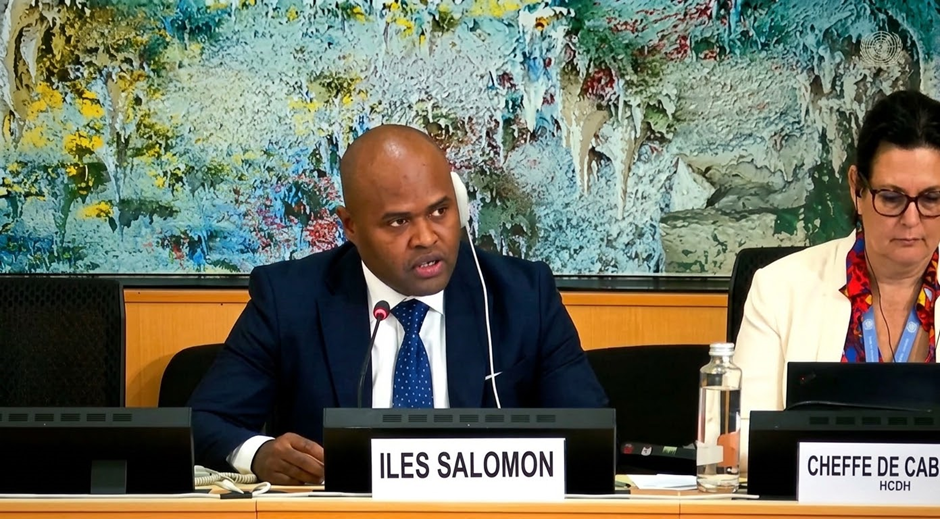
Chargé d'Affaires of the Permanent Mission of Solomon Islands to the United Nations Office at Geneva, Mr. Martin Kwaifono during the adoption process.
Human Rights Council Adopts Solomon Islands’ Fourth UPR Outcomes
The United Nations Human Rights Council, during its 63rd Session in Geneva, Switzerland, has adopted the outcomes of Solomon Islands’ Fourth Universal Periodic Review (UPR).
Solomon Islands recalled its participation in the 52nd Session of the UPR Working Group on 11 May 2026, during which it presented its national report and engaged in an interactive dialogue with Member States. Solomon Islands received a total of 181 recommendations.
The Solomon Islands delegation reaffirmed that human rights are guaranteed under the Constitution and national legislation and reiterated the Government’s commitment to the principles of universality, indivisibility and interdependence of all human rights.
The delegation expressed appreciation to the Office of the United Nations High Commissioner for Human Rights, the Troika comprising China, Malawi and Switzerland, the Commonwealth Small States Office and all participating Member States for their support throughout the review process.
Solomon Islands also underscored its continued support for the UPR as a cooperative, transparent and constructive mechanism that promotes accountability, dialogue and multilateralism.
Following consideration of the recommendations received, Solomon Islands supported 140 recommendations and noted 41 recommendations.
In presenting developments since the review, the Solomon Islands delegation highlighted the country’s recent accession to the United Nations Convention against Transnational Organized Crime.
The delegation stated that this demonstrated the Government’s commitment to addressing transnational organised crime, including human trafficking, and called for continued international cooperation and capacity-building support.
The delegation also reiterated that the establishment of a national human rights institution in accordance with the Paris Principles remains a national priority. It indicated that efforts would be accelerated towards establishing an independent and fully functional institution before the next review cycle.
Solomon Islands further emphasised that its national development agenda is closely aligned with its human rights commitments.
Key priorities include universal free education, the development of energy, telecommunications and other critical infrastructure, constitutional and governance reforms, reforms in the mining sector, modernisation of financial institutions, climate change mitigation and resilience, and the promotion of disability inclusion.
These efforts form part of a broader commitment to integrating human rights into sustainable development and ensuring that no one is left behind.
Regarding the 41 recommendations that were noted, the delegation stressed that this should not be interpreted as a lack of commitment to human rights.
As a least developed country and small island developing State, Solomon Islands emphasised the importance of ensuring that adequate resources and implementation capacity are available before assuming additional international obligations.
The delegation noted that further consultations with relevant authorities and stakeholders would be required and called on international partners to provide technical assistance and capacity-building support.
In concluding, the Solomon Islands delegation reaffirmed the Government’s commitment to fulfilling its human rights obligations and advancing the welfare, dignity and rights of all Solomon Islanders.
The Ministry of Foreign Affairs and External Trade acknowledges and extends its appreciation to the Ministry of Justice and Legal Affairs, the Ministry of Women, Youth, Children and Family Affairs, all relevant government ministries and agencies, and Solomon Islands’ regional and international partners for their tireless work, cooperation and support towards the preparation and presentation of the report.
–MFAET PRESS RELEASE