

Pacific BioScapes Programme Convenes Third Steering Committee Meeting in Solomon Islands to Strengthen Regional Biodiversity Conservation
HONIARA, SOLOMON ISLANDS | 16 October 2026
The Pacific BioScapes Programme held itsThird Programme Steering Committee (PSC) Meeting in Honiara, Solomon Islands, from 13–15 October 2026, bringing together regional partners, government representatives and implementing partners to review progress and provide strategic guidance for the programme’s remaining implementation period and closure phase.
Hosted by the Solomon Islands Government through the Ministry of Environment, Climate Change, Disaster Management and Meteorology (MECDM), the meeting provides an important opportunity to strengthen regional collaboration, share lessons from participating countries and ensure the programme’s achievements deliver lasting benefits for Pacific communities.
In his opening remarks, MECDM Deputy Secretary Corporate Mr Karl Kuper welcomed delegates to Honiara, emphasising the importance of collective regional action in addressing climate change, biodiversity loss, unsustainable natural resource use and other environmental and socioeconomic challenges.
“Your presence here reflects our strong regional partnership, ongoing collaboration and shared commitment in serving our people as we continue to address increasing pressure of climate change, biodiversity loss, unsustainable use of natural resources, and other environmental and socio-economic challenges,” Mr Kuper said.
He reaffirmed the Solomon Islands Government’s commitment to working with international and regional partners, development partners, non-governmental organisations, community-based organisations and local communities to address these challenges.
Mr Kuper also highlighted the programme’s alignment with the Solomon Islands’ national environmental priorities, including the National Biodiversity Strategy and Action Plan, which is currently under review, the Community-Based Resource Management Strategy and the National Climate Change Policy.
Community-led conservation delivering results
Mr Kuper highlighted the Pacific BioScapes Programme’s contribution to strengthening community capacity in natural resource management and governance in the Solomon Islands. The Solomon Islands Project titled “Integrated Island and ocean management in Central Province, Solomon Islands, for biodiversity, livelihoods and wellbeing outcomes,” has been implemented by SPREP in partnership with the Wildlife Conservation Society (WCS) – Solomon Islands and in collaboration MECDM, the Ministry of Fisheries and Marine Resources and the Central Provincial Government.
Key efforts include training and the establishment of Resource Management Committees to support the implementation of community management plans. Early observations from community leaders indicate positive behavioural changes in natural resource management, improved compliance with community management rules and better waste management practices across land and marine environments.
A significant milestone has been achieved in the Russell Islands, where the Marulaon and Karumulun communities recently launched their Community Fisheries Management Plans. The plans mark an important step towards strengthening ecosystem-based approaches to marine conservation and fisheries management, building on more than a decade of community-led efforts.
Mr Kuper noted that strong community ownership of the planning and development process demonstrates the value of locally driven conservation initiatives in improving biodiversity, livelihoods and community wellbeing.
“These outcomes demonstrate our collective action and vision to improve biodiversity, livelihoods and wellbeing of our communities,” he said.
Strengthening regional partnerships and long-term impact
The Pacific BioScapes Programme aims to contribute to the sustainable development of Pacific Small Island Developing States (SIDS) by supporting improved management and sustainable use of marine and coastal resources.
The programme focuses on two key result areas: strengthening the capacity of Pacific countries to manage coastal and marine biodiversity and enhance climate resilience; and supporting regional, national and local efforts to assess, conserve, protect, manage and sustainably use marine and terrestrial biodiversity.
It supports a portfolio of 30 projects across 11 countries and at the regional level, working in partnership with national governments, regional organisations, communities and implementing partners.
Over the three days, delegates reviewed progress across the programme’s projects, assess its overall approach and implementation strategy, and provide guidance on priorities for the remaining implementation period. Discussions also focused on ensuring alignment and complementarity with existing regional, sub-regional and national policies and strategies, strengthening programme governance, and planning for a sustainable programme closure.
“As we gather for this third Steering Committee meeting, it is important that we take this time to reflect on what has been achieved, what didn’t go well and might need improvements, and what more can be done to ensure that the Pacific BioScapes contributes to a lasting impact for our people and communities beyond the project’s timeline,” Mr Kuper said.
Delegates also had the opportunity in visiting Soka Community in Ngella Islands to witness the official launch and handing over of the Soka Community Fisheries Management Plan – a key milestone for the community.
The field visit also provided practical insights into community-led initiatives and highlight the importance of maintaining local ownership and partnerships to sustain environmental outcomes beyond the programme’s implementation period.
A shared commitment to the Blue Pacific
The Solomon Islands Government has acknowledged the European Union’s financial support and the Pacific Regional Environment Programme (SPREP)’s leadership and coordination of the Pacific BioScapes Programme, alongside the contributions of participating Pacific Island governments, implementing partners, provincial and sub-national governments, communities and civil society organisations.
Through continued collaboration, the Pacific BioScapes Programme and its partners are working towards a resilient Blue Pacific where marine and terrestrial biodiversity is protected, natural resources are sustainably managed, and communities continue to benefit from healthy ecosystems.
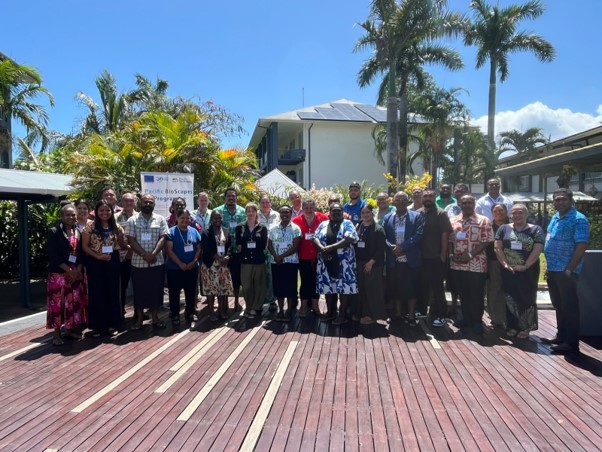
(Participant from EU, SPREP, Regional representatives from other Pacific Island countries with Solomon Islands SPREP rep and MECDM team pose for a group photo after the meeting).
ENDS