

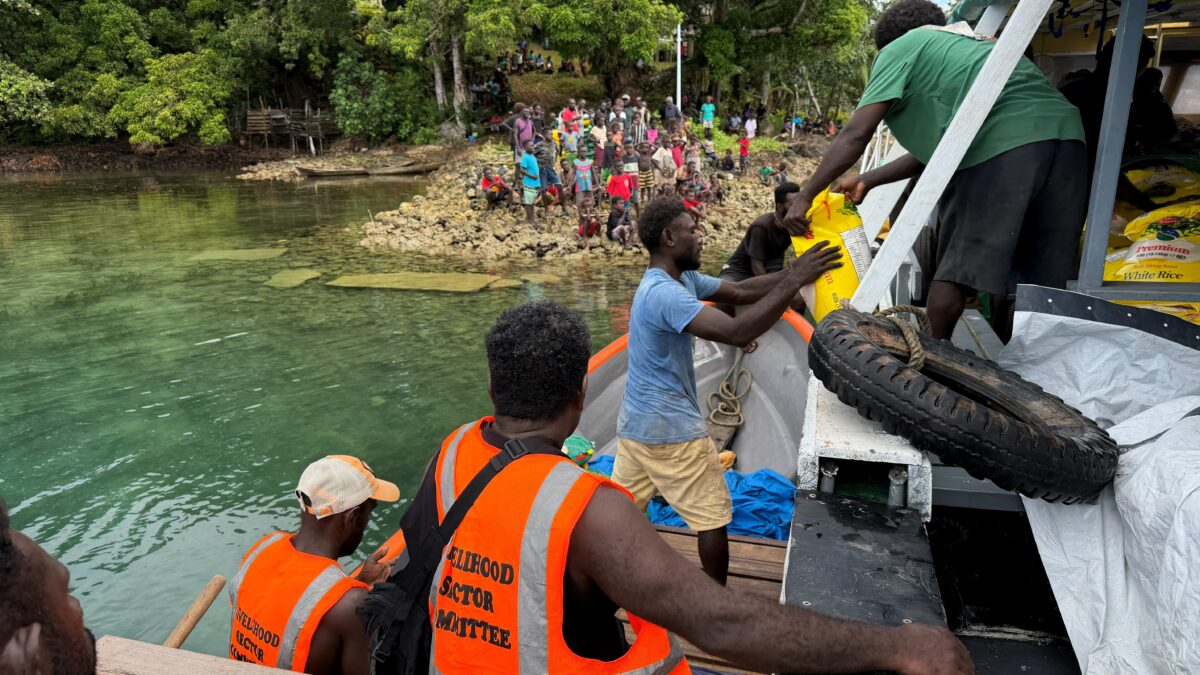
Food relief operations led by the Provincial Disaster Operations Committee (P-DOC) Livelihood Sector Committee in Western Province are steadily progressing as response teams work to reach communities impacted by Tropical Cyclone Maila.
Food Relief Operations Progress in Western Province Following Tropical Cyclone Maila
Under the provincial disaster response arrangement, the Livelihood Sector Committee is responsible for supporting food security and sustaining the livelihoods of affected populations. Working in close coordination with national authorities and local partners, the committee has been distributing essential food supplies primarily rice to communities experiencing the greatest need.
Chief Field Officer for Western Province and Chairman of the P-DOC Livelihood Sector Committee, Sipuru Rove, said that several affected areas have already received assistance.
“So far, we have carried out food distribution in Simbo, South West Ranonga, North Vella, and the Shortlands. This is not yet complete, as we are prioritising the red zones, areas that are severely affected by the cyclone,” Rove said.
Initial damage assessments (IDA) remain ongoing, with red zones currently identified in Simbo, parts of Ranonga, northern Vella La Vella, and sections of the Shortlands. However, reaching all affected communities continues to be a challenge due to limited transport options.
“One of our main challenges is the lack of reliable logistics to move food relief supplies,” Rove explained. We have engaged available vessels, but they have operational limitations, and access to some communities remains difficult.”
The committee is also facing challenges in gathering timely and accurate data from communities to guide relief efforts. With some areas yet to report their situation, ensuring equitable distribution remains complex.
“I do not always have readily available disaster information, so I rely heavily on contacts within the communities and also our team’s assessments. While many have come forward, not all communities have reported in, and that makes it a challenge to ensure everyone is covered. However, we will still cover all affected areas”
Despite these challenges, feedback from affected communities highlights the importance of the assistance being delivered.
Susan Liton from Saevuke on Ranggo Island said the relief has been critical for families whose food sources were destroyed.
“The food relief supplies have helped our communities and families. Our gardens were badly damaged by the cyclone, so this support is helping us feed our families while we begin replanting,” she said.
Rove reassured communities that efforts are ongoing to reach all affected areas.
“We are doing everything possible to reach you. There are challenges, but we ask for your patience as we continue assessments and organise distribution,” he said.
The Livelihood Sector Committee operates as part of the National Disaster Operations Committee framework, chaired by the Ministry of Agriculture and Livestock Development the committee members include other relevant government ministries. At the provincial level, it works through the P-DOC to implement national strategies, coordinate food security responses, and support rural livelihoods. This integrated approach ensures that relief efforts are aligned, informed by data, and responsive to the needs of communities during emergencies.
MALD assessment team is expected to continue with damage assessment and distribution of food relief in the coming weeks. It is providing some chainsaws and tools to heavily affected communities to help with clearing of fallen trees and removal of debris caused by the TC Maila.
MALD thanked all the communities that it had visited for their support to its field staffs as we make combined recovery efforts from destruction caused by TC Maila.
Ends//
MALD Press Release