

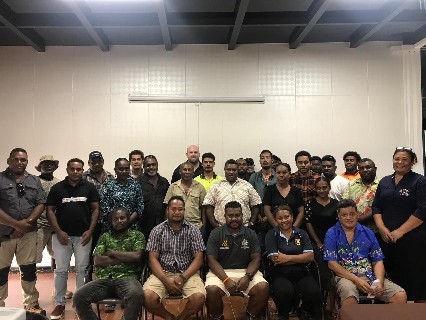
Group photo of participants from Government agencies, HCC, MID, ECD and other private constructors who attend the workshop with Alex Wood facilitator of the workshop.
ASBESTOS MANAGEMENT TRAINING WORKSHOP END SUCCESSFULLY
The Environmental and Conservation Division (ECD) under the Ministry of Environment, Climate Change, Disaster Management and Meteorology (MECDM), with the EU-funded Pac Waste Plus Project through the South Pacific Regional Environment Program (SPREP) has successfully ended the asbestos management training held from 25th– 27th March, 2025.
The workshop aims to provide crucial information and raise awareness on the proper identification, removal, and handling of asbestos, as well as non-fibrous asbestos.
Mr. Alex Wood facilitator of the workshop, an expert of asbestos management from More Environmental Consultancy, New Zealand, highlights the importance of careful managing of asbestos in the Solomon Islands
Mr. Wood highlights that asbestos is a well-established cause of severe health conditions, including lung diseases and various forms of cancer.
He also said that No level of asbestos exposure is considered safe, and all forms of asbestos have been proven to cause cancer in humans. The risk of health problems arises when asbestos fibers become airborne, as they can be inhaled, leading to exposure.
Therefore, people dealing with asbestos especially constructors must be adhering when managing asbestos in any forms.
Deputy Director of Environment and Conservation Division (ECD) Ms. Debra Kereseka stated in her opening remarks that Solomon Islands is a party to three of the five major international agreements concerning hazardous chemicals and wastes: the Waigani Convention, the Stockholm Convention, and the Basel Convention. As a party to these agreements, Solomon Islands is required to develop national regulations to align with these conventions. These national laws provide the framework for managing asbestos and ensuring compliance with international standards.
Ms Kereseka said that the introduction of an Asbestos Management Policy and Regulation, including a ban on the importation of asbestos, will be a significant step toward reducing asbestos-related diseases. Relevant national laws and regulations, such as the Environment Act 1998, the Customs and Excise (Amendment) Act (Chap 121), and the Safety at Work Act 1982, already exist to help support these measures.
She said the upcoming National Building Standard Bill, which will regulate building materials, including asbestos-containing materials, will further strengthening our legal framework.
“We hope you will leave this training with a deeper understanding of the health risks associated with asbestos and ACM, and with the knowledge needed to manage these materials safely and effectively”.
The attendees of the workshop are those from the government Agencies including Ministry of Infrastructure Development (MID), EHD/MHMS, Guadalcanal Province, Waste and Pollution Control Team from HCC, Private construction companies and Environment and Conservation Division within the Ministry of Environment, Climate Change Disaster Management and Meteorology.
END///
MECDM Press