

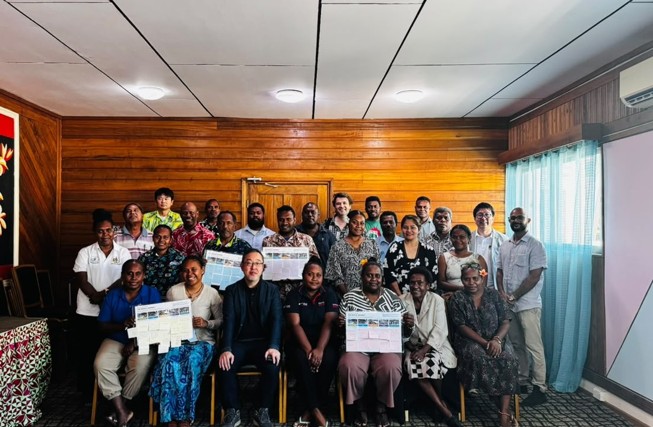
Representatives from MECDM, Government ministries, HCC, Private Sector, Civil Society and Development partners and the participants of the EM SUMP Workshop pose for a group photo after the workshop.
Solomon Islands Launches Sustainable Urban Mobility Planning for a Safer, More Accessible and Greener Honiara
Honiara, Solomon Islands, 17 November 2026 – The Government of Solomon Islands has taken another important step towards improving urban transport in its capital, with the launch of the Honiara Sustainable Urban Mobility Plan (SUMP) development process. The initiative aims to address growing traffic congestion, road safety concerns and accessibility challenges while supporting the country’s transition towards low-emission and sustainable transport.
The first SUMP workshop, held at Honiara Hotel, brought together representatives from government ministries and agencies, Honiara City Council, transport sector stakeholders from the private sector, civil society and development partners to initiate a coordinated approach to planning the city’s future mobility needs.
The workshop was convened by the Ministry of Environment, Climate Change, Disaster Management and Meteorology (MECDM) and the Global Green Growth Institute (GGGI) under the “Transformation to Low/Zero Emissions Transport Sector – Enabling Uptake of Electric Mobility in Solomon Islands” project. The project is funded by the Global Environment Facility (GEF), implemented by the United Nations Environment Programme (UNEP), and executed by MECDM with technical support from GGGI.[1]
As Honiara continues to grow, increasing vehicle ownership and limited road infrastructure are placing growing pressure on the city’s transport system. Traffic congestion, inadequate pedestrian facilities, road safety concerns and limited access to reliable transport services are affecting daily mobility, economic productivity and quality of life. The Sustainable Urban Mobility Plan seeks to address these challenges through an integrated, people-centered approach that considers not only how vehicles move, but also how residents access employment, education, healthcare, markets and other essential services.
Opening the workshop, the Deputy Secretary Technical of MECDM, Ms. Agnetha Vave-Karamui highlighted the importance of looking beyond vehicle electrification to address the broader mobility needs of Honiara. “Ultimately, the success of our transport system should be measured not only by how quickly vehicles move, but by how safely and easily people can reach the places and services they need,” the Deputy Secretary emphasized.
The SUMP will provide an evidence-based framework to identify and prioritize practical improvements to public transport, walking and cycling infrastructure, road safety, accessibility and traffic management. It will also strengthen the integration of transport planning with urban development and identify short-, medium- and long-term investment priorities.
Inclusive mobility will be at the heart of SUMP design, recognizing the different transport needs and challenges experienced by women, students, children, older persons, persons with disabilities and communities dependent on public transport.
Mr. Mohammad Ali Shaikh, GGGI Country Representative for Papua New Guinea, Solomon Islands and Vanuatu, highlighted the broader economic and development benefits of sustainable urban mobility planning and the importance of translating plans into practical investments.
“Our priority is to ensure that this process delivers more than a planning document. We want to help translate the priorities identified by government and stakeholders into practical, implementable and investment-ready interventions,” he said.
During the workshop, technical experts from GGGI introduced the proposed methodology, workplan and stakeholder engagement approach for developing the SUMP. Participants discussed Honiara’s mobility challenges, identified priority areas for further assessment and provided initial feedback to guide the planning process. Drawing on their own experiences as Honiara residents, participants highlighted the challenges they encounter throughout their daily journeys, from walking out of their homes to reaching their final destinations, navigation the particularities of Honiara’s unique public transport system – providing the SUMP team with valuable firsthand insights and practical priorities to inform the development of the plan.
The workshop also featured discussions with development partners on tactical urbanism and the Honiara pilot initiatives, highlighting opportunities to complement long-term transport planning with practical, targeted improvements to streets and public spaces that can enhance pedestrian safety and accessibility.
The development of the SUMP builds on the Government’s wider efforts to advance sustainable transport and electric mobility, aligned with Solomon Islands’ Nationally Determined Contribution 3.0, Low Emissions Development Strategy 2021 and National Electric Mobility Policy 2022.
The next phase will involve detailed mobility assessments, stakeholder consultations and the identification and prioritization of interventions, together with institutional responsibilities and implementation arrangements. The process will seek to establish a practical investment framework that can guide coordinated action by government, development partners and the private sector. The final SUMP is expected to be delivered by March 2028.
Through this initiative, Solomon Islands is laying the foundation for a more integrated, inclusive and climate-resilient urban transport system that reduces emissions, improves road safety, strengthens accessibility and creates a more liveable Honiara.