

SOLOMON ISLANDS CALLS FOR STRONGER INTERNATIONAL SUPPORT TO ENSURE A JUST AND INCLUSIVE CLIMATE TRANSITION
Antalya, Türkiye – 16 November 2026
The Solomon Islands Government has called for stronger international cooperation, technical assistance and access to climate-friendly technologies to ensure that developing countries, particularly Small Island Developing States (SIDS) and Least Developed Countries (LDCs), are not left behind in the global transition to low-emission and climate-resilient development.
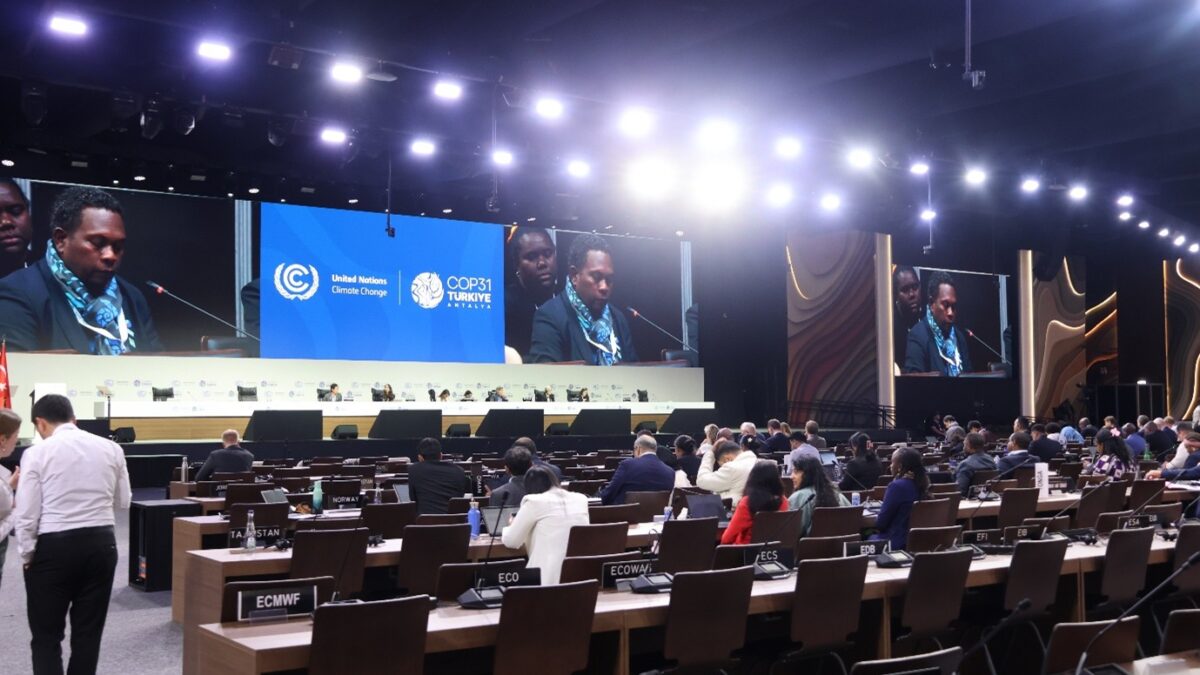
The call was made by the Minister for Environment, Climate Change, Disaster Management and Meteorology, Hon. Wayne Ghemu, during the Fourth Annual High-Level Ministerial Roundtable on Just Transition, held today at COP31 in Antalya, Türkiye.
The Minister emphasised that a just transition must reflect each country’s national circumstances, development priorities and capacity to manage the economic and social impacts of moving towards cleaner and more resilient development pathways. Solomon Islands aligned itself with statements delivered by Samoa on behalf of the Alliance of Small Island States (AOSIS) and Vanuatu on behalf of the Pacific Small Island Developing States (PSIDS), reaffirming the region’s collective call for equitable and inclusive climate transition pathways.
In his intervention, Minister Ghemu highlighted that while Solomon Islands has made progress in establishing national climate and development policy frameworks, translating these commitments into practical action remains challenging.
He noted that much of the country’s existing infrastructure, skills and institutional capacity have been developed around fossil fuels, while the transition to renewable energy and climate-resilient systems requires substantial upfront investment, technology and technical expertise.
“For Solomon Islands, a transition cannot be considered just simply because it is fast or technically achievable. Our transition pathways must take into account our national circumstances, limited resources and the social and economic realities of our people,” the Minister emphasised.
The Minister welcomed the establishment of the Just Transition Mechanism under Decision 2/CMA.7 at COP30, describing it as an important opportunity to strengthen international cooperation, technical assistance, capacity-building and knowledge-sharing to support developing countries.
He stressed that the Mechanism must be implementation-focused, equitable and responsive to the vulnerabilities and limited resource base of SIDS. It should facilitate access to environmentally sound technologies, technical expertise and practical support to help countries implement their just transition pathways while strengthening resilience.
Minister Ghemu further called for the operationalisation of the Mechanism to advance at COP31 and remain closely aligned with the review of the UAE Just Transition Work Programme.
He highlighted the importance of strengthening its linkages with relevant UNFCCC processes, including the Global Stocktake, Nationally Determined Contributions (NDCs) and National Adaptation Plans (NAPs). The Minister also emphasised that the Mechanism’s institutional arrangements and governance should remain firmly grounded within the UNFCCC process, recognise the special circumstances of SIDS and support transition pathways consistent with the 1.5°C temperature goal.
The Fourth Annual High-Level Ministerial Roundtable forms part of the UAE Just Transition Work Programme established under the Paris Agreement. It provides a platform for Ministers to assess progress, exchange experiences and provide political direction on advancing fair and inclusive transition pathways.
The Roundtable also considered how the newly established Just Transition Mechanism can complement the existing Work Programme and strengthen support for implementation at local, national and international levels.
Solomon Islands reaffirmed its commitment to a just and inclusive transition that advances low-emission and climate-resilient development while protecting livelihoods, strengthening national resilience and ensuring that no one is left behind.