

SOLOMON ISLANDS MAKES HISTORY AS FIRST PACIFIC ISLAND COUNTRIES TO UNDERGO PARIS AGREEMENT TRANSPARENCY PROCESS
Antalya, Türkiye – 14 November 2026
The Solomon Islands Government has achieved a significant milestone in its climate action journey following the successful completion of its first Biennial Transparency Report (BTR1) and participation in the Facilitative Multilateral Consideration of Progress (FMCP) under the Paris Agreement’s Enhanced Transparency Framework (ETF).
Together with Vanuatu, Solomon Islands is among the first Pacific Small Island Developing States (PSIDS) to undergo the FMCP process, demonstrating the Pacific’s commitment to transparency, accountability and effective implementation of the Paris Agreement.
For Solomon Islands, a Small Island Developing State on the front line of the climate crisis, transparency is an accountability mechanism than an international reporting obligation. It is a critical tool for strengthening climate governance, informing evidence-based decisions, tracking national climate commitments, mobilising international support and accelerating climate action.
The country’s first BTR establishes an important foundation for reporting greenhouse gas emissions, tracking progress towards its Nationally Determined Contribution (NDC), documenting adaptation efforts and identifying financial, technical and capacity-building needs.
The FMCP is an important component of the Paris Agreement’s Enhanced Transparency Framework. It provides an opportunity for countries to present and discuss progress in implementing their NDCs, respond to questions from other Parties, share experiences and identify areas for improvement. It is a facilitative process, not a compliance or enforcement mechanism, promoting mutual learning, transparency, trust and accountability among Parties.
The FMCP follows the submission of a country’s BTR and its Technical Expert Review (TER). For Solomon Islands, the TER assessed the completeness, transparency and consistency of BTR1 and provided recommendations to strengthen future reporting, including improvements to data management, greenhouse gas inventories, quality assurance and NDC tracking methodologies.
Participation in the FMCP therefore marks an important next step in the country’s transparency journey, allowing Solomon Islands to demonstrate progress, share its experiences and challenges, and highlight the continued need for international financial, technical and capacity-building support.
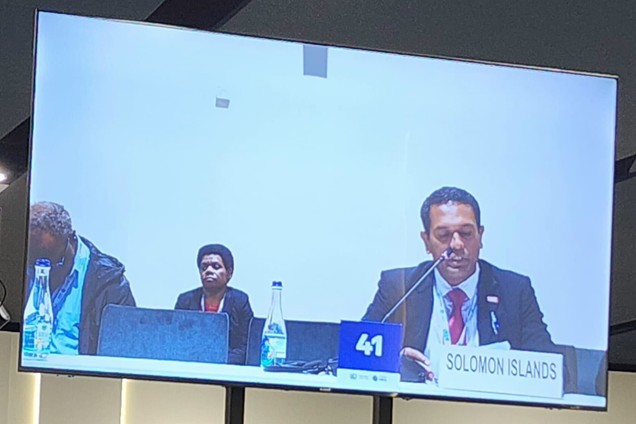
Representing the Government, Mr. Karl Kuper, Deputy Secretary of the Ministry of Environment, Climate Change, Disaster Management and Meteorology (MECDM), delivered the introductory statement during the session. He was supported by Mr. Henry Tufah, Deputy Director, and Mr. David Tufi, Chief Mitigation Officer of the Climate Change Division (CCD), who responded to questions raised by participating Parties.
The development of BTR1 has also strengthened collaboration across government ministries, technical institutions, civil society organisations and development partners, building national expertise, improving institutional coordination and laying the foundation for a sustainable national transparency system.
Mr. Kuper emphasised that while Solomon Islands has made important progress, sustained technical, financial and capacity-building support remains essential to strengthen national transparency arrangements. Continued investment in national expertise, data management systems, climate finance reporting and greenhouse gas inventory development will be critical to improving future reporting.
Looking ahead, MECDM, through the leadership of the Climate Change Division, will commence preparations for the Second and Third Biennial Transparency Reports (BTR2 and BTR3) and the Fourth National Communication (NC4).
Solomon Islands remains committed to the Paris Agreement and to continuously strengthening its national transparency arrangements. The experience gained through BTR1, the TER and FMCP reinforces that transparency is not only about international accountability; it is also essential for informing national priorities, strengthening climate planning and delivering better development outcomes for the people of Solomon Islands.
The Ministry acknowledges the contributions of government agencies, the private sector, civil society, academic institutions and development partners, and calls for continued collaboration and partnership to strengthen national capacity and advance climate action under the Paris Agreement.
ENDS