

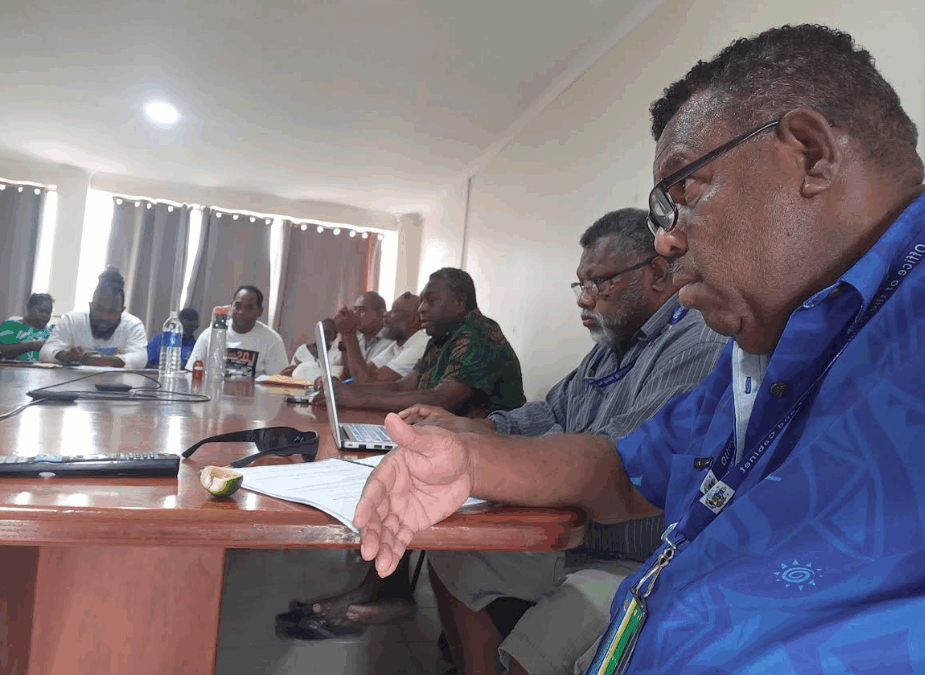
Policy Secretary Productive Sector Nixon Kua and the Faifatala’a Kava Association with Ben from Serenco Labs
Faifatala’a kava farmers poised to unlock major economic opportunity
Honiara, 13 August 2026: The significant economic potential of kava farming in Faifatala’a in West Kwara’ae, Malaita Province was highlighted during a meeting between the Productive Sector of the Prime Minister’s Office Policy Implementation, Monitoring and Evaluation Unit [PIMEU], the Ministry of Commerce, Industry, Labour and Immigration [MCILI], the Faifatala’a Kava Association, and Serenco Labs, a New Zealand-based kava buyer.
The meeting, held at the MCILI conference room, was attended by Faifatala’a farmers’ representative Mr Lazarus Maetoloa and a Serenco Labs representative.
Discussions focused on growing international demand for Solomon Islands kava and the potential to expand the industry.
Serenco Labs is already purchasing commercially suitable Faifatala’a kava, but farmers are currently unable to meet demand consistently.
A major constraint is transporting harvested kava from the mountainous terrain of Faifatala’a to the buying point in Auki. Other challenges include poor road access, harvesting difficulties, post-harvest processing, reliable energy, quality control, and capacity to operate commercially.
The proposed Faifatala’a Pilot Production Community and Auki Provincial Kava Hub 2026–2031 aims to address these constraints through a plantation-to-market model linking production, transport, processing, quality assurance, value addition, and export.
Faifatala’a currently has approximately 45 households, 19 hectares of established kava, and 102,000 plants in the ground.
Based on a planning assumption of one kilogram of saleable dried kava per mature plant at SBD $300 per kilogram, these existing plants represent a theoretical production potential of 102 tonnes, with an indicative gross farm-gate value of approximately SBD $30.6 million.
Approximately 12,950 three-year-old plants are expected to provide the first significant commercial harvest from January 2027.
The programme also targets 225,000 new plants annually, equivalent to about 45 hectares. At full production, each annual planting cohort could eventually generate approximately SBD $67.5 million in gross farm-gate value.
The Serenco Labs representative highlighted the quality of Solomon Islands kava, particularly its high kavalactone content — the key compounds associated with kava’s calming and relaxing effects.
He said strong interest from overseas buyers shows the main challenge is no longer market demand, but the ability of local farmers to produce, aggregate, process and reliably supply commercial quantities.
Serenco Labs also noted the potential for Solomon Islanders to generate income in their own communities through kava farming. He added that some PALM workers could potentially earn more by remaining in their villages and investing their labour in commercial kava production, provided reliable markets and supporting infrastructure are available.
Improving access between Faifatala’a and Auki is critical. The challenges highlight the relevance of the GREAT Coalition’s Strategic Corridors policy, which seeks to develop infrastructure and economic corridors to connect production areas with markets.
For Faifatala’a, improved road connectivity could reduce transport costs and post-harvest losses, increase volumes reaching Auki, and strengthen the link between farmers, the proposed Auki Provincial Kava Hub, and export markets. This places the Ministry of Infrastructure Development [MID] in a key position to support emerging productive-sector opportunities like kava.
The initiative also aligns with the GREAT Coalition’s focus on indigenous SME development, local content, and value addition.
The proposed Auki Kava Hub would support aggregation, quality assurance, drying, grinding, packaging, value-added products, and export preparation. Renewable energy is also proposed to support processing operations.
For the Productive Sector of PIMEU, the initiative demonstrates the Iumi Tugeda approach — bringing together indigenous producers, government, infrastructure, private-sector investment, and international markets.
If key constraints are addressed, Faifatala’a could transform the substantial value of kava already growing in its highlands into sustained household incomes, rural employment, indigenous businesses, and export earnings.
The longer-term ambition is to establish Faifatala’a as a pilot model for a commercially viable kava industry that can be replicated in other kava-growing communities throughout the Solomon Islands.
[ENDS]