

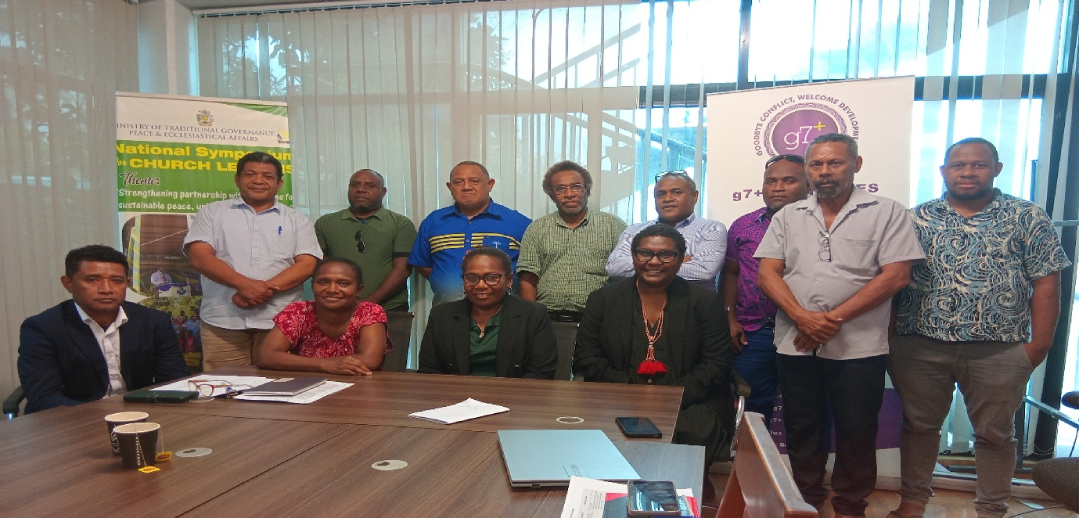
The Legislative and Policy Subcommittee and Officials from the MTGPEA
GREAT Coalition pushes development-led peace and governance reform with MTGPEA
Honiara, 12 August 2026: The Prime Minister’s Office Legislative and Policy Subcommittee last week successfully conducted a consultation with the Ministry of Traditional Governance, Peace and Ecclesiastical Affairs on strengthening governance and addressing post-conflict challenges.
The consultation held on 5 August 2026 underscored the enduring legacy of the Truth and Reconciliation Commission Report, which called for reparations and reforms to strengthen traditional governance.
The Permanent Secretary, Mr Lottie Vaisekavea, emphasises that, according to Part II of the TRC Report, customary land disputes were identified as a root cause of conflict in the Solomon Islands.
In response, one of the key reforms advanced is the introduction of statutory consent based on Free, Prior and Informed Consent for all customary land, ensuring fairness, transparency, and respect for indigenous practices, and enabling the peace spirit of the church to transcend to its members who are also indigenous tribal members.
This shifts the mandate of the ministry from post-Conflict peacebuilding, which neglected the root issues, to development-led peace, dealing directly with the root issue as a developmental response.
The consultation also considered empowering and enabling community governance, informed choices and decisions.
The Ministry is working on the following proposed bills: the FPIC-based statutory consent for all customary land, the customary governance bill and the Stewardship bill.
The consultation reflects the Great Coalition’s guiding principles of Rule of Law, Transparency and Accountability and Social Cohesion, Culture and Community Wellbeing.
It also advances the Coalition’s flagship program on decentralisation and inclusive governance, which seeks to empower provincial and community institutions with resources, authority, and accountability.
The reforms are consistent with the coalition’s Solomonisation principle, placing local leadership, knowledge, and institutions at the centre of national development.
By embedding cultural relevance and sustainability, the government ensures that development programs reflect the values, traditions, and aspirations of all Solomon Islanders.
The Legislative and Policy Subcommittee and MTGPEA will continue to progress legal reform work in cohort with the Law Reform Commission to advance development-led peace and legislative reforms that safeguard stability and promote sustainable development.
These efforts form part of the coalition’s broader mission to build a strong, secure, peaceful, and prosperous Solomon Islands, guided by credible leadership and democracy.
-ENDS-