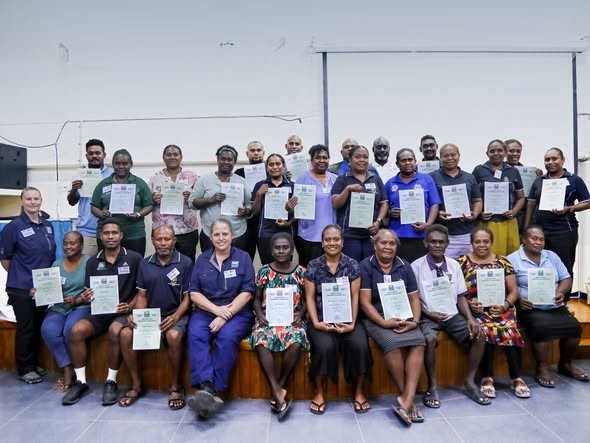
NCCTRC. RIDE Course Participants
RIDE Training Boosts Disaster Response and Rehabilitation Readiness
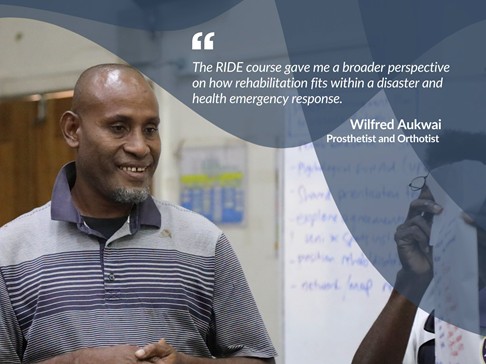
A two-day course on Rehabilitation in Disasters and Emergencies (RIDE) was successfully conducted from 23–24 June 2026. The course was delivered by the National Critical Care and Trauma Response Centre (NCCTRC) through its Regional Engagement Program (REP), funded by the Australian Government, and was held at the National Referral Hospital Conference Room.
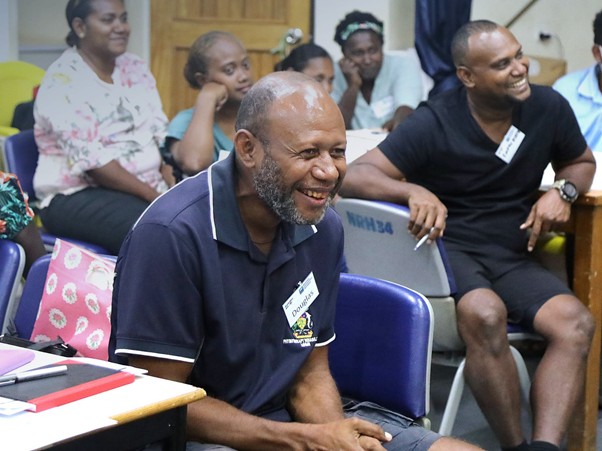
The course brought together physiotherapists, a prosthetic technician, Community-Based Rehabilitation (CBR) Field Officers, nurses, maintenance officers, and logistics personnel from the National Referral Hospital, as well as participants from Western, Choiseul, Guadalcanal, and Malaita Provinces. Representatives from the Ministry of Health and Medical Services (MHMS), including the PHESU Coordinator, along with participants from Solomon Islands National University (SINU) and the Solomon Islands National Institute of Sport (SINIS), also attended.
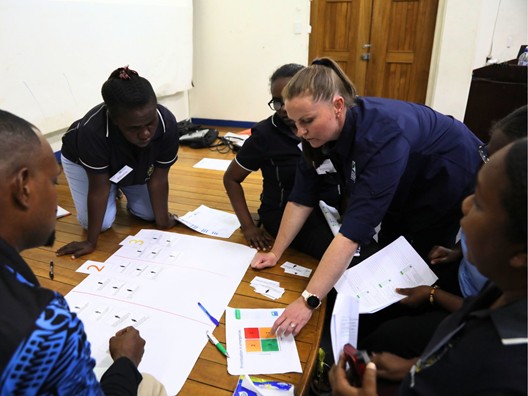
The course aimed to increase and strengthen participants’ knowledge and skills to support the delivery of rehabilitation services during disasters and emergencies through practical exercises and group discussions.
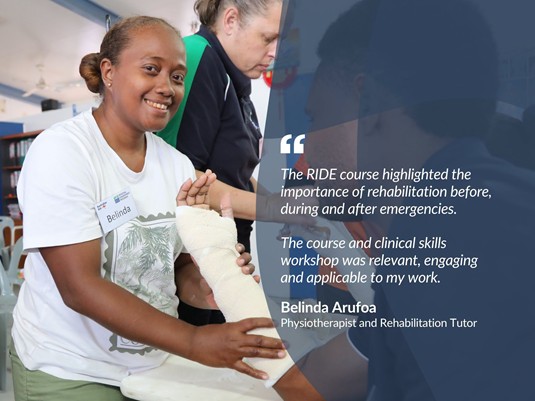
Following the RIDE course, a one-day Continuous Professional Development (CPD) workshop was conducted on Thursday, 25 June 2026. The workshop focused on clinical rehabilitation skills that support patient recovery, including early mobilization, respiratory care, and fracture management.
Director of the National Rehabilitation and Disability Division, Mrs. Elsie Taloafiri, stated that this course was the first of its kind conducted for rehabilitation professionals, and they look forward to organizing similar courses in the future. She highlighted that the course was organized by the Division in collaboration with NCCTRC as part of the implementation of the Solomon Islands Rehabilitation Strategic Plan, contributing to the development of a disaster and emergency rehabilitation plan.
On behalf of the Division under the Ministry of Health and Medical Services, Mrs. Taloafiri acknowledged NCCTRC for delivering the course with funding support from the Australian Government. She also expressed appreciation to Mr. Rolly Viga, PHESU Coordinator, who participated in the course by presenting an overview of the Solomon Islands Disaster Management Arrangement. His presentation included the health and rehabilitation components aligned with disaster management and coordination across the preparedness, response, and recovery phases.
End////