

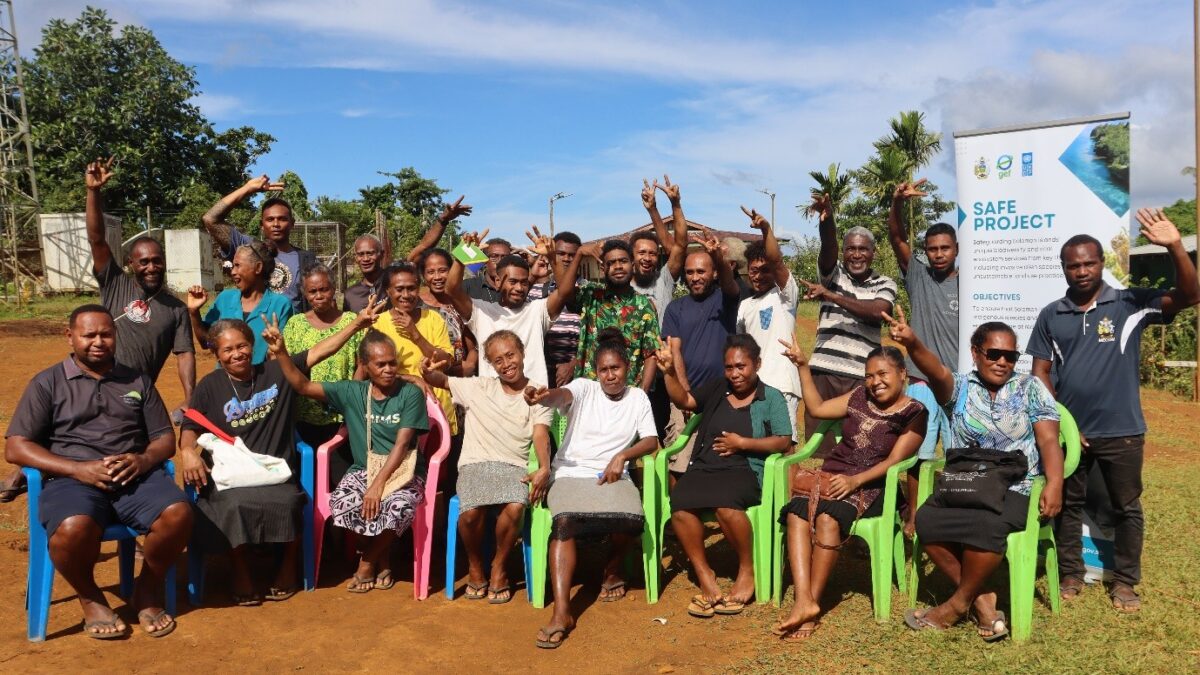
Members of the Hageulu community pose for a group photo with representatives from MECDM, UNDP, and the SAFE Project following the completion of the four-day consultation workshop on conserving endemic Tubi forests in Isabel Province).
SAFE PROJECT CONCLUDES FOUR-DAY COMMUNITY CONSULTATION WORKSHOP ON CONSERVING ENDEMIC TUBI FORESTS IN ISABEL PROVINCE
HAGEULU, ISABEL PROVINCE – The Safeguarding Solomon Islands Endemic and Globally Threatened Biodiversity and Ecosystem Services (SAFE) Project, under the Ministry of Environment, Climate Change, Disaster Management and Meteorology (MECDM), has successfully concluded a four-day induction and consultation workshop focused on the conservation of the endemic Tubi tree species in the communities of Hageulu and Kolomola in Isabel Province.
The workshop was conducted to raise awareness among local communities about the ecological significance of their natural resources and the important role they play in supporting Solomon Islands’ biodiversity conservation efforts for future generations.
Solomon Islands is home to rich biodiversity that supports the livelihood, cultures, and wellbeing of its people. However, increasing threats such as habitat loss, invasive alien species, unsustainable resource use, and climate change continue to place significant pressure on the country’s unique ecosystems.
In response to these challenges, the SAFE Project with funding from the Global Environment Facility (GEF) and is implemented by MECDM in partnership with the United Nations Development Programme (UNDP). The project aims to safeguard native species, combat land degradation, promote sustainable resource management, and strengthen ecosystem resilience across the country.
The project adopts an integrated approach that focuses on strengthening environmental governance, supporting community participation, improving land and sea management practices, and promoting sustainable livelihood opportunities.
The SAFE Project is implemented through four key components:
- Component 1: Enabling framework for safeguarding biodiversity, combating land degradation, and securing a nature-based economy.
- Component 2: Comprehensive risk management approach to address invasive alien species (IAS) threats to biodiversity and land degradation.
- Component 3: Community-based integrated ecosystem management and threat reduction at the land and seascape scale.
- Component 4: Knowledge management, awareness, monitoring and evaluation, and gender mainstreaming.
Speaking during the workshop opening, National Programmes Coordinator of MECDM ‘s Project Management and Coordination Unit, Mr. Sammy Airahua highlighted the significance of the Tubi tree (Xanthostemon melanoxylon), describing it as an extremely rare and culturally important hardwood species commonly referred to as the ‘Iron Tree’ due to its exceptionally dense and durable timber.
“The Tubi tree is prized for its dark, dense, and durable timber. It is one of the Solomon Islands’ most unique endemic tree species and requires urgent conservation efforts,” Mr. Airahua said.
He emphasized that successful conservation cannot be achieved by government agencies alone and requires strong collaboration with local communities.
“The Ministry is looking at the uniqueness of the Tubi forests in Hageulu and Kolomola as a valuable national resource that must be conserved and protected. Isabel and Choiseul Provinces are the only provinces where this unique species naturally occurs, making its preservation critically important,” he added.
Responding on behalf of the Hageulu community, Chief Stephen Tanihorara welcomed the initiative and acknowledged the efforts of MECDM, the SAFE Project, and UNDP in bringing conservation awareness to the people of Hageulu.
“This initiative has paved the way forward for our people to seriously consider conserving the Tubi resources we have for future generations,” Chief Tanihorara said.
“We will now work through our community committee and collaborate closely with the SAFE Project, MECDM, and UNDP to develop a community-led roadmap for protecting and sustainably managing our Tubi forest within customary land boundaries”
Chief Tanihorara further noted that the community has witnessed the environmental impacts of logging and mining activities in other parts of the country and remains committed to pursuing environmentally sustainable development pathways.
“We have seen the impacts of logging and mining around our islands, and we do not want similar challenges to affect our people in the future. Therefore, we welcome development approaches that are environmentally responsible and sustainable,” he said.
In his closing remarks, Chief Tanihorara expressed appreciation to MECDM, the SAFE Project team, and the UNDP provincial representative for travelling to the remote highlands of Hageulu to engage directly with the community.
The SAFE Project is a nationally significant initiative funded through the Global Environment Facility (GEF-7) and implemented by MECDM in partnership with UNDP. The project supports Solomon Islands’ commitments to biodiversity conservation, ecosystem resilience, sustainable land management, and community-led stewardship of the nation’s unique natural heritage.