

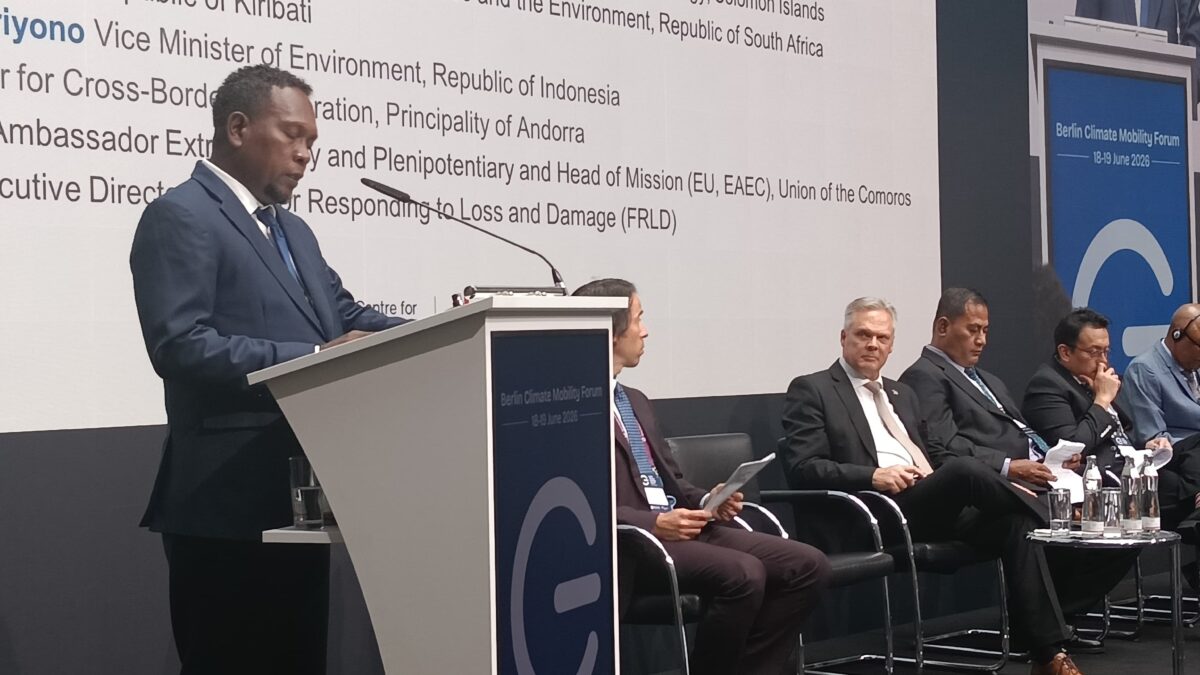
Minister delivering his remarks
Solomon Islands Endorses Global Principles for Climate Mobility and Solidifies Strategic Partnership with UNOPS/GCCM
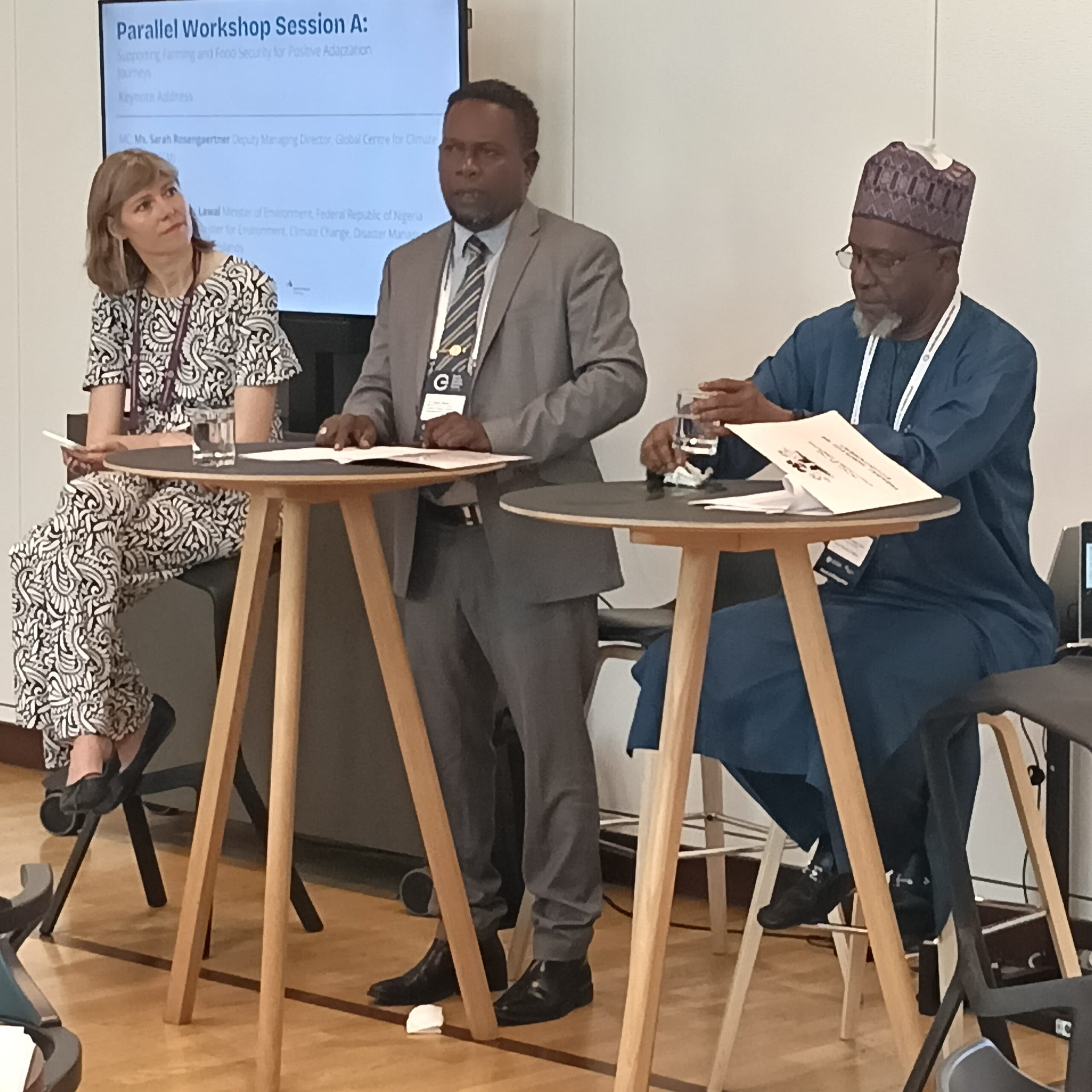
Minister at the signing of the MoU
BERLIN, Germany — June 18, 2026 — The Solomon Islands Government has formally endorsed the Global Principles for Addressing Climate Mobility during the 2nd Climate Mobility Forum in Berlin. Addressing an audience of world leaders and delegates, the Minister for Environment, Climate Change, Disaster Management and Meteorology (MECDM), Honorable Wayne Ghemu, emphasized that for the Solomon Islands, the climate crisis is no longer a future threat but a present reality reshaping the nation’s coastlines.
Minister Ghemu highlighted the devastating impact of rising sea levels, noting that five reef islands have disappeared and six others have suffered severe erosion in recent decades. He cited the community of Nuatambu, where families have lost three-quarters of their homes, and Walande, where 800 people were forced to relocate to the mainland.
“Protecting people in a warming world means protecting their right to choose—to stay where they can, to move when they must, and to do either with dignity and agency,” Minister Ghemu stated.
To operationalize this vision, the Government of the Solomon Islands has entered into a Memorandum of Understanding (MOU) with the United Nations Office for Project Services (UNOPS) to establish a comprehensive framework for cooperation on climate-related human mobility. The MoU was signed by the Minister during the course of forum in Berlin, Germany. This partnership, centred on “The Solomon Islands Climate Mobility Deep Dive,” directly supports the Minister’s three strategic pillars which are;
The Right to Stay: Prioritizing investments in resilient infrastructure and coastal protection to allow communities to remain on ancestral lands. Through the Pacific Climate Mobility Initiative (PCMI), the partnership will establish a baseline of climate mobility knowledge and projections to inform local adaptation planning. Additionally, the Communities Climate Adaptation Facility (C-CAF) will mobilize financing for community-led solutions that enable people to remain in place and build resilience against immediate threats.
Mobility with Dignity: Ensuring that when relocation is unavoidable, it is planned, voluntary, and community-led. A key component of the new partnership is the development of a National Blueprint—a country-specific agenda for action—and a climate mobility country profile created through consultative processes. This blueprint will be used to upgrade the National Adaptation Plan and Nationally Determined Contribution.
Inclusive Support: Guaranteeing that the most vulnerable are not left behind. The partnership utilizes UNOPS’s expertise to expand implementation capacity and help those in need through effective project services, as outlined in the UNOPS Strategic Plan 2026-2029.
Minister Ghemu also raised concerns regarding national sovereignty and maritime zones, calling for international cooperation to provide legal certainty for small island developing states. This is reinforced by the MOU’s focus on the Rising Nations Initiative (RNI), which seeks to strengthen national capacity regarding statehood continuity and the protection of livelihoods, culture, and heritage.
The Minster concluded with a call for adaptation finance to reach the local level. Under the MOU, the Parties will jointly develop evidence-based proposals for international climate financing institutions to fund dedicated institutional capacities and projects. Furthermore, the Solomon Islands will work with the Global Centre for Climate Mobility (GCCM) to advance global advocacy through forums like the Coalition for addressing Sea-level rise & its Existential Threats (C-SET).
“Together, let us ensure that climate mobility responses uphold dignity, human rights, cultural identity, and resilience,” said Minister Ghemu, “so that our people can live with security and pride in the face of a changing climate.”
Ends//